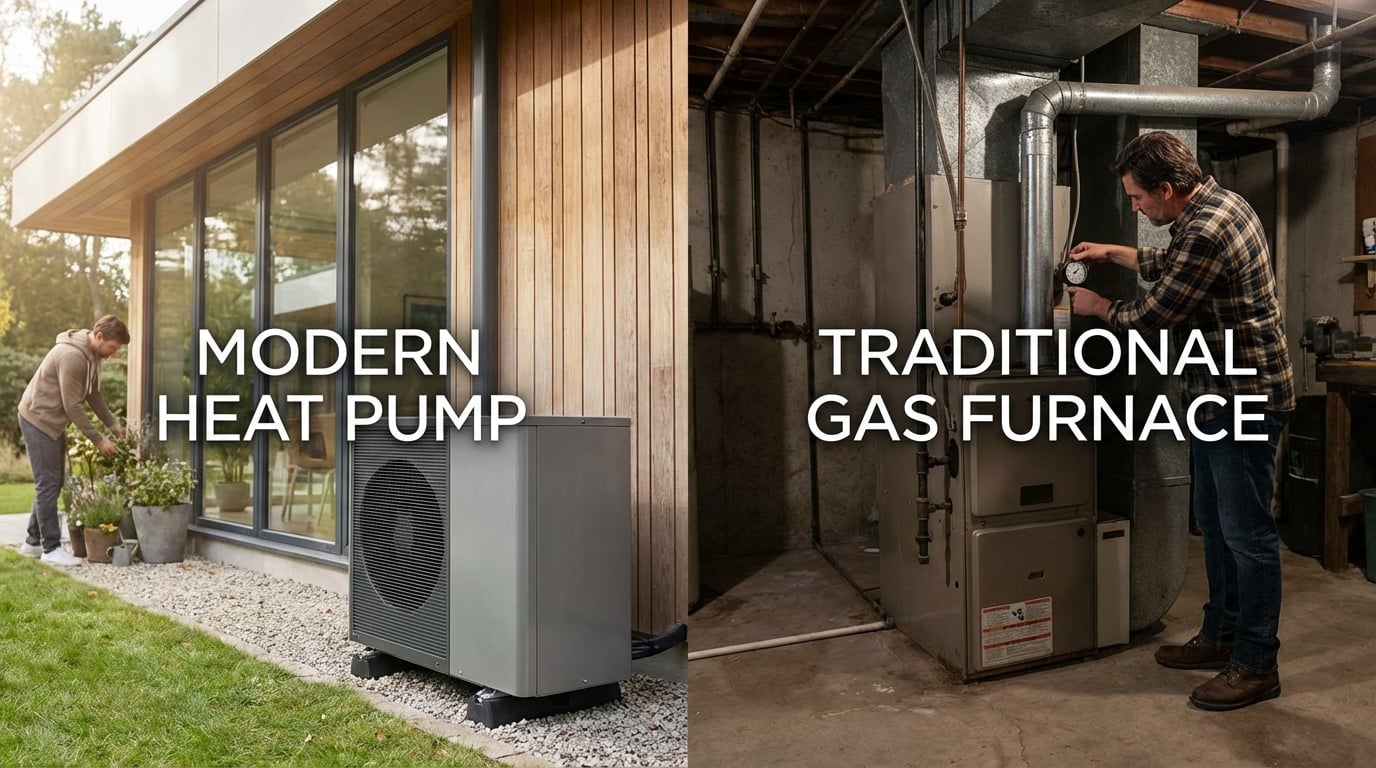
Heat Pump vs. Furnace: Which Heating System Is Right for Your Home? (2026 Comparison)
A heat pump heats and cools your home by moving heat between indoors and outdoors using electricity, while a furnace burns fuel (natural gas, propane, or oil) to generate heat. Heat pumps cost $4,000–$12,000 installed and operate at 200–400% efficiency, making them cheaper to run in moderate climates. Gas furnaces cost $3,000–$8,000 installed and provide stronger heating output in extreme cold, though they max out at 98% efficiency and require a separate AC system for cooling.
Key Takeaways
- Heat pump advantage: Heats AND cools — eliminates the need for a separate AC unit, saving $3,000–$5,000
- Furnace advantage: Delivers hotter air (120–140°F vs. 90–110°F from heat pumps) and performs reliably at sub-zero temperatures
- Operating cost: Heat pumps cost 20–50% less to run annually than gas furnaces in climate zones 1–4 (roughly south of the Mason-Dixon line)
- Upfront cost: A furnace + AC combo costs $7,000–$15,000 total vs. $4,000–$12,000 for a heat pump that does both
- Best compromise: Dual-fuel systems pair a heat pump with a gas furnace backup, using each when it’s most efficient
- Tax credits: Heat pumps qualify for up to $2,000 federal tax credit under the Inflation Reduction Act; furnaces get $0
What’s in This Guide
How Heat Pumps and Furnaces Work
Heat Pumps: Moving Heat Instead of Making It
A heat pump works like a reversible air conditioner. In winter, it extracts heat from outdoor air (even cold air contains heat energy down to about -15°F) and transfers it indoors using a refrigerant cycle. In summer, it reverses the process, pulling heat from your home and releasing it outside — functioning as a standard air conditioner. This dual functionality is the heat pump’s biggest practical advantage: one system replaces both your furnace and your AC.
Because heat pumps move existing heat rather than generating it from fuel, they achieve 200–400% efficiency (also expressed as a COP of 2.0–4.0 or HSPF2 of 7.5–13.5). That means for every $1 of electricity consumed, a heat pump delivers $2–$4 worth of heating energy. No combustion-based system can exceed 100% efficiency — they’re limited by the energy content of the fuel they burn.
Furnaces: Combustion Heating
A gas furnace burns natural gas (or propane/oil) in a sealed combustion chamber, then blows heated air through your ductwork via a blower fan. Modern high-efficiency furnaces achieve 95–98% AFUE (Annual Fuel Utilization Efficiency), meaning 95–98 cents of every dollar spent on gas becomes heat. The remaining 2–5% escapes as exhaust through the flue pipe.
Furnaces excel at one thing: producing very hot air quickly. A gas furnace delivers supply air at 120–140°F, which feels noticeably warm from the register. Heat pumps deliver air at 90–110°F — still warm enough to heat your home effectively, but it doesn’t feel as “hot” blowing from the vents. This is a common complaint among homeowners switching from furnaces to heat pumps, though it doesn’t affect the actual room temperature achieved.
Upfront Cost: Heat Pump vs. Furnace
| System | Equipment Cost | Installation | Total Installed |
|---|---|---|---|
| Heat pump (air-source) | $2,500–$7,000 | $1,500–$5,000 | $4,000–$12,000 |
| Gas furnace only | $1,500–$4,000 | $1,500–$4,000 | $3,000–$8,000 |
| Gas furnace + central AC | $3,500–$8,000 | $3,500–$7,000 | $7,000–$15,000 |
| Dual-fuel (heat pump + furnace) | $4,500–$10,000 | $3,000–$6,000 | $7,500–$16,000 |
| Geothermal heat pump | $3,500–$8,000 | $14,500–$27,000 | $18,000–$35,000 |
The comparison that matters most is heat pump vs. furnace + AC combined, since a furnace alone doesn’t provide cooling. When you factor in the $3,000–$5,000 cost of a separate air conditioning system, a heat pump often costs less upfront while providing both heating and cooling in a single unit.
Annual Operating Cost: Heat Pump vs. Gas Furnace
| Climate Zone | Heat Pump (Heat + Cool) | Gas Furnace + AC | Annual Savings w/ Heat Pump |
|---|---|---|---|
| Hot/mild (FL, TX, AZ, SoCal) | $800–$1,300 | $1,400–$2,200 | $400–$900 |
| Mixed/moderate (NC, TN, VA, NorCal) | $1,000–$1,800 | $1,600–$2,600 | $300–$800 |
| Cold (PA, OH, IN, NJ) | $1,400–$2,200 | $1,800–$2,800 | $100–$600 |
| Very cold (MN, WI, ME, MT) | $1,800–$3,000 | $2,000–$3,000 | $0–$200 (or higher with gas) |
These figures assume $1.20/therm natural gas and $0.16/kWh electricity — close to national averages. Your actual savings depend heavily on local utility rates. In states with cheap electricity and expensive gas (like much of the Southeast), heat pumps save significantly more. In states with cheap gas and expensive electricity (parts of the Midwest), the operating cost advantage shrinks or disappears.
Heat Pump vs. Furnace Efficiency Explained
Efficiency is where these two systems differ most dramatically, and it’s where the comparison gets confusing because they use different metrics:
| Metric | Applies To | What It Measures | Range |
|---|---|---|---|
| AFUE | Furnaces | % of fuel energy converted to heat | 80–98% |
| HSPF2 | Heat pumps | BTU of heat output per watt-hour of electricity | 7.5–13.5 |
| COP | Heat pumps | Units of heat output per unit of electricity input | 2.0–4.5 |
| SEER2 | Heat pumps & AC | Cooling efficiency (BTU per watt-hour) | 13.4–22+ |
The key insight: a 96% AFUE furnace sounds efficient, but a heat pump with a COP of 3.0 is effectively 300% efficient. The furnace converts 96% of fuel energy to heat. The heat pump delivers 3x more heat energy than the electrical energy it consumes. These aren’t directly comparable because the fuels (gas vs. electricity) have different costs per BTU, which is why operating cost comparisons matter more than efficiency ratings alone.
Which System Is Better for Your Climate?
Climate Zones 1–3 (hot and warm regions — TX, FL, AZ, GA, SC, SoCal): Heat pumps are the clear winner. Temperatures rarely drop below 25°F, so heat pumps maintain high efficiency year-round. These regions also have heavy cooling loads where heat pumps pull double duty. The operating cost savings are substantial ($400–$900/year), and the $2,000 tax credit makes the upfront cost competitive with furnace + AC systems.
Climate Zone 4 (mixed — NC, TN, VA, KY, parts of CA, OR): Heat pumps are strongly favored. Winter temperatures occasionally dip into the teens but rarely stay there. Modern cold-climate heat pumps handle these conditions efficiently. This zone represents the sweet spot: meaningful heating loads where heat pump savings add up, plus moderate cooling loads. Most HVAC contractors in these regions now recommend heat pumps as the default choice for replacement systems.
Climate Zone 5 (cold — PA, OH, NJ, IN, IL, CO): Heat pumps work well, but the case is closer. Standard heat pumps lose efficiency during the coldest weeks of winter. Cold-climate models (Mitsubishi Hyper-Heat, Bosch, Daikin Aurora) maintain performance down to -5 to -15°F and are the right choice here. A dual-fuel system — heat pump with gas furnace backup — is also excellent for this zone, using the heat pump 80–90% of the time and switching to gas only during extreme cold.
Climate Zones 6–7 (very cold — MN, WI, ME, ND, MT): Dual-fuel systems or cold-climate heat pumps are recommended. Extended periods below 0°F stress even cold-climate heat pumps. A dual-fuel setup uses the heat pump whenever it’s more efficient than gas (typically above 25–35°F) and switches to the furnace below that threshold. This captures most of the operating cost savings while ensuring reliable heat in the worst conditions. Standalone gas furnaces are still a reasonable choice in these zones, especially for homeowners with access to cheap natural gas.
Dual-Fuel Systems: The Best of Both Worlds
A dual-fuel system (also called a hybrid heating system) pairs an air-source heat pump with a gas furnace. A thermostat or control board automatically switches between the two based on outdoor temperature, using whichever system is more cost-efficient at that moment.
How it works: Above the “balance point” (typically 25–35°F, adjustable by your installer), the heat pump operates because it’s cheaper per BTU than gas. Below the balance point, the system switches to the gas furnace because the heat pump’s efficiency has dropped enough that gas becomes the cheaper option. The exact balance point depends on your local gas and electricity prices.
Cost: $7,500–$16,000 installed. This is more expensive upfront than either system alone, but the operating cost savings — using the cheapest fuel at all times — typically pay back the premium in 5–8 years in cold climates.
Best for: Homeowners in climate zones 4–6 who want the efficiency of a heat pump without giving up the reliability of gas backup. Also ideal if you already have a working gas furnace and want to add a heat pump without removing the existing system.
Heat Pump vs. Furnace: Side-by-Side Comparison
| Factor | Heat Pump | Gas Furnace |
|---|---|---|
| Heating + cooling | Both in one unit | Heating only — need separate AC ($3,000–$5,000) |
| Installed cost | $4,000–$12,000 | $3,000–$8,000 (furnace only); $7,000–$15,000 (+ AC) |
| Annual operating cost | $800–$2,200 (heating + cooling) | $1,400–$3,000 (gas heating + electric cooling) |
| Efficiency | 200–400% (COP 2.0–4.0) | 80–98% AFUE |
| Supply air temp | 90–110°F | 120–140°F |
| Cold weather performance | Efficiency drops below 25°F; cold-climate models work to -15°F | Unaffected by outdoor temperature |
| Fuel source | Electricity only | Natural gas, propane, or oil |
| Carbon emissions | Lower (zero if paired with solar) | Higher (direct combustion) |
| Lifespan | 15–20 years | 15–25 years |
| Safety | No combustion — no CO risk | Requires CO detectors; annual inspection recommended |
| Federal tax credit | Up to $2,000 (through 2032) | $0 |
| Maintenance | Annual tune-up ($100–$200); filter changes | Annual inspection ($80–$150); filter changes; combustion check |
When to Choose a Heat Pump vs. a Furnace
Choose a Heat Pump If:
You live in a mild-to-moderate climate. If winter temperatures in your area rarely drop below 20°F, a heat pump will outperform a furnace on both cost and comfort. Climate zones 1–4 are ideal territory.
You need to replace both your furnace and AC. If both systems are aging, a single heat pump replaces both for less total cost than two separate units. This is the most common scenario where heat pumps save the most money.
You want lower energy bills. In most of the country, heat pumps reduce annual HVAC costs by $300–$900 compared to gas furnace + AC systems. The savings are highest in regions with moderate electricity rates and heavy cooling loads.
You want to reduce your carbon footprint. Heat pumps produce no direct emissions. Even accounting for the electricity generation mix, they produce 40–60% less CO2 than gas furnaces in most U.S. states. Paired with rooftop solar, emissions drop to near zero.
You want to take advantage of tax credits. The $2,000 federal tax credit for heat pumps is available through 2032. Many states and utilities offer additional rebates of $500–$5,000, making heat pumps significantly cheaper than furnaces after incentives.
Choose a Gas Furnace If:
You live in a very cold climate and have cheap natural gas. In climate zones 6–7 with gas prices below $0.80/therm, a high-efficiency gas furnace may cost less to operate than a heat pump, especially during extended cold snaps.
Your electrical panel can’t support a heat pump. Heat pumps require a 30–60 amp dedicated circuit. If your home has an older 100-amp panel that’s already near capacity, you may need a $1,500–$4,000 electrical panel upgrade before installing a heat pump. A gas furnace only needs a standard 15-amp circuit for the blower.
You already have a new AC system. If your central AC is less than 5 years old and working well, replacing just the furnace (not the AC) with a gas furnace is the most cost-effective near-term option. You can add a heat pump when the AC eventually needs replacement.
You prefer the feel of hotter supply air. Some homeowners prefer the 120–140°F air from a furnace over the 90–110°F air from a heat pump. Both achieve the same room temperature, but the furnace’s hotter air feels more satisfying from the register.
Find Heat Pump Installers Near You
Compare quotes from certified HVAC contractors. Read reviews, check credentials, and find the best installer for your home.
Frequently Asked Questions
Is a heat pump better than a furnace?
For most U.S. homes, a heat pump is the better choice. It provides both heating and cooling in one system, costs 20–50% less to operate annually, qualifies for $2,000 in federal tax credits, and produces no combustion emissions. Heat pumps are especially advantageous in climate zones 1–4 (roughly the southern two-thirds of the country). In very cold climates (zones 6–7), a gas furnace or dual-fuel system may be more practical for consistent performance during extended sub-zero cold snaps.
How much does it cost to switch from a furnace to a heat pump?
Switching from a gas furnace to a heat pump costs $4,000–$12,000 for a standard air-source system, minus the $2,000 federal tax credit ($2,000–$10,000 net). If your home needs an electrical panel upgrade to support the heat pump, add $1,500–$4,000. If you’re also eliminating a separate AC unit, the heat pump replaces both systems, making it cost-competitive with a furnace + AC replacement ($7,000–$15,000). For a full heat pump installation cost breakdown, see our detailed guide.
Why is my heat pump bill so high?
High heat pump bills usually result from one of four issues: the system is running on backup electric resistance heat (check if the “auxiliary heat” or “emergency heat” light is frequently on), the heat pump is undersized for your home, your home has poor insulation or air leaks, or electricity rates in your area are higher than average. Have an HVAC technician verify the system is sized correctly, check that the outdoor unit isn’t iced over or blocked, and consider a home energy audit to identify insulation or air sealing problems.
Do heat pumps work in cold weather?
Yes — modern cold-climate heat pumps are rated for operation down to -15°F or colder. Models from Mitsubishi (Hyper-Heat), Bosch, and Daikin (Aurora) maintain 70–80% of their rated heating capacity at 5°F. Standard heat pumps start losing significant efficiency below 25–30°F and may need backup heat below 15°F. For homes in climate zones 5–7, choose a cold-climate rated model or install a dual-fuel system with gas furnace backup for the coldest days.
What is a dual-fuel heat pump system?
A dual-fuel system combines an air-source heat pump with a gas furnace. The heat pump handles heating and cooling when outdoor temperatures are above the “balance point” (typically 25–35°F), and the system automatically switches to the gas furnace when temperatures drop below that threshold. This approach uses the cheapest energy source at all times — electricity when the heat pump is most efficient, gas when it’s more economical. Dual-fuel systems cost $7,500–$16,000 installed and are ideal for cold climates (zones 4–6).
How long do heat pumps last compared to furnaces?
Heat pumps typically last 15–20 years; gas furnaces last 15–25 years. Heat pumps have a shorter average lifespan because they run year-round (heating in winter, cooling in summer), putting more wear on the compressor than a furnace that only operates during the heating season. However, a heat pump replaces both the furnace and AC, so its lifespan should be compared to both systems’ replacement cycles. A geothermal heat pump offers the longest lifespan: 20–25 years for the heat pump unit, 50+ years for the ground loop.
Heat pump vs. furnace: which is cheaper to run?
In most of the U.S., a heat pump is cheaper to run than a gas furnace + AC combination. Annual savings range from $300–$900 in mild climates to $100–$400 in cold climates. The heat pump wins because it operates at 200–400% efficiency vs. the furnace’s 80–98%, and it provides cooling without a separate AC unit. The furnace may be cheaper to operate only where natural gas is very inexpensive (below $0.80/therm) AND electricity is expensive (above $0.20/kWh) AND winters are severe — a combination found mainly in parts of the upper Midwest.
Why don’t more contractors recommend heat pumps?
Some HVAC contractors are less familiar with heat pump installation and sizing, particularly in regions where gas furnaces have been the dominant technology for decades. Heat pump installation requires different training (refrigerant handling, electrical work) than furnace installation (gas line work, combustion venting). Additionally, contractor margins on furnace replacements can be higher because furnaces are a well-established commodity product. This is changing rapidly — the heat pump market grew 40%+ from 2020 to 2024 — and most contractors are now expanding their heat pump expertise to meet demand.
Related Guides
- Heat Pump Installation Cost Guide — full breakdown of heat pump pricing by type and size
- Geothermal Heating Cost Guide — ground-source heat pump costs, ROI, and tax credits
- Home Energy Audit Guide — optimize your home before upgrading your HVAC system
- Spray Foam Insulation Cost Guide — reduce heating loads to get the most from your heat pump