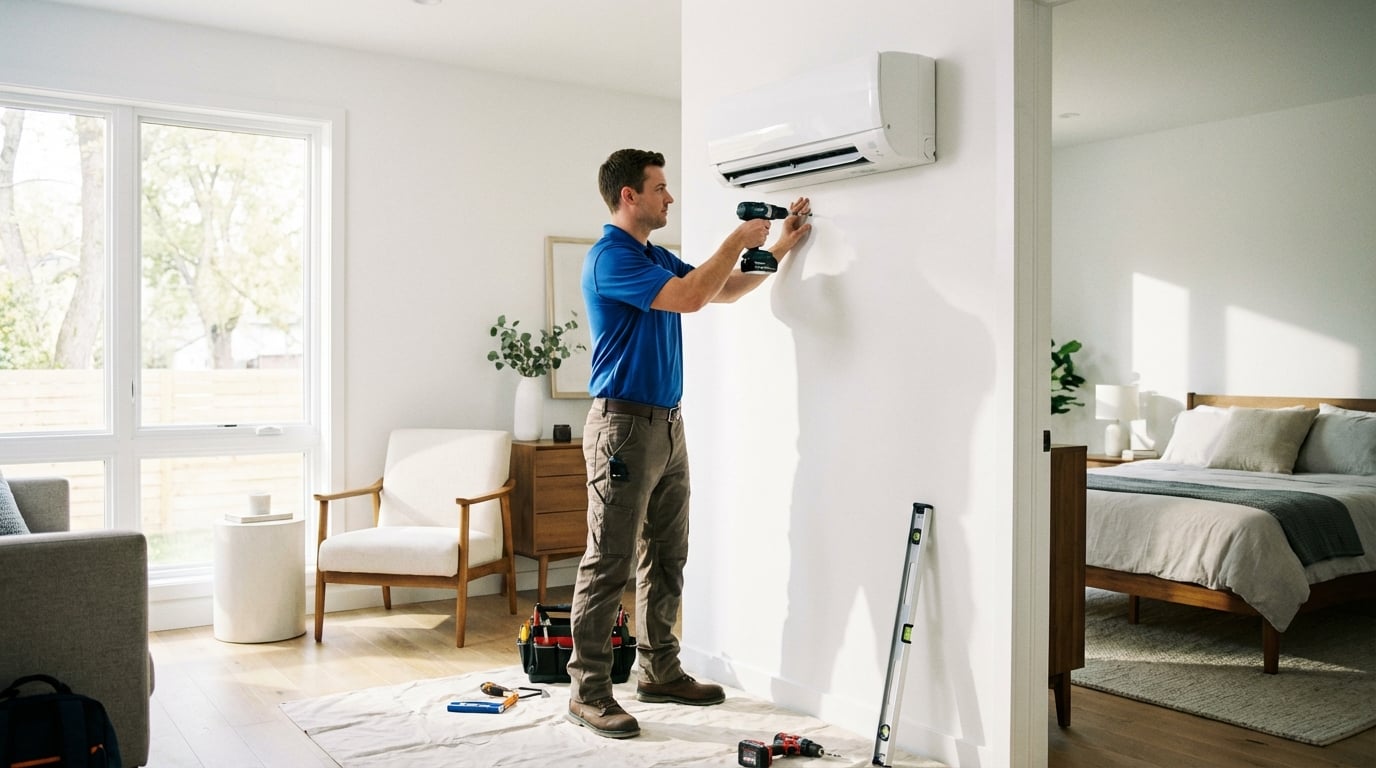
Heat Pump Installation Cost in 2026 (Full Pricing Breakdown)
A heat pump costs $4,000–12,000 to install for a standard central air-source system, with the national average around $8,000. After the $2,000 federal tax credit, most homeowners pay $2,000–10,000 out of pocket. Mini-split (ductless) heat pumps cost $3,000–8,000 for a single-zone system and $8,000–18,000 for multi-zone. Geothermal heat pumps are the most expensive at $18,000–35,000 but offer the lowest operating costs and qualify for a 30% uncapped tax credit.
Key Takeaways
- Central air-source heat pump: $4,000–12,000 installed (national average: ~$8,000)
- Ductless mini-split: $3,000–8,000 (single zone); $8,000–18,000 (multi-zone)
- Geothermal: $18,000–35,000 before the 30% uncapped tax credit
- Federal tax credit: Up to $2,000 for air-source; 30% with no cap for geothermal
- Operating savings: 20–50% lower heating/cooling costs vs. traditional HVAC
- Cost factors: System type, size (tonnage), efficiency rating, ductwork needs, and labor rates
What’s in This Guide
Heat Pump Cost by Type
| Heat Pump Type | Total Installed Cost | After Tax Credit | Best For |
|---|---|---|---|
| Central air-source (ducted) | $4,000–12,000 | $2,000–10,000 | Homes with existing ductwork |
| Mini-split (single zone) | $3,000–8,000 | $1,000–6,000 | Room additions, homes without ducts |
| Mini-split (multi-zone, 2–4 heads) | $8,000–18,000 | $6,000–16,000 | Whole-home ductless, zoned comfort |
| Dual-fuel (heat pump + furnace) | $7,500–16,000 | $5,500–14,000 | Cold climates with gas access |
| Geothermal (ground-source) | $18,000–35,000 | $12,600–24,500 | Long-term owners, all climates |
Central ducted heat pumps are the most common type for homes that already have ductwork from an existing furnace or AC system. The outdoor unit (condenser) connects to an indoor air handler or pairs with your existing furnace blower. This is the easiest and cheapest option if your home already has ducts in good condition.
Mini-split heat pumps use individual wall-mounted or ceiling-mounted indoor units connected to an outdoor condenser by refrigerant lines — no ductwork needed. Each indoor unit (called a “head”) controls the temperature in its zone independently. This makes them ideal for homes without existing ducts, room additions, converted garages, or any space where running ductwork is impractical or expensive.
Geothermal heat pumps use the constant temperature underground (rather than outdoor air) for heat exchange, achieving 300–500% efficiency. The ground loop adds significant installation cost but lasts 50+ years. For a complete breakdown, see our geothermal heating cost guide.
Heat Pump Installation Cost Breakdown
| Component | Cost Range | Details |
|---|---|---|
| Heat pump unit (outdoor) | $2,000–5,500 | 2–5 ton; price varies by efficiency and brand |
| Air handler / indoor unit | $800–2,500 | Not needed if pairing with existing furnace blower |
| Installation labor | $1,500–4,000 | 8–16 hours; higher for attic or difficult access |
| Thermostat | $150–400 | Smart thermostat recommended for heat pump optimization |
| Refrigerant lines | $200–600 | Copper line set connecting indoor and outdoor units |
| Electrical work | $200–1,500 | Dedicated circuit, disconnect; panel upgrade if needed |
| Permits and inspection | $100–500 | Required in most jurisdictions; covers HVAC and electrical |
| Ductwork modifications | $0–3,000 | $0 if existing ducts are adequate; more if resizing needed |
| Concrete pad | $100–300 | Outdoor unit mounting; some use composite pads |
Heat Pump Cost by Home Size
| Home Size | System Size | Installed Cost | After $2,000 Credit |
|---|---|---|---|
| 800–1,200 sq ft | 1.5–2 ton | $3,500–7,000 | $1,500–5,000 |
| 1,200–1,800 sq ft | 2–2.5 ton | $4,500–8,500 | $2,500–6,500 |
| 1,800–2,400 sq ft | 3–3.5 ton | $5,500–10,000 | $3,500–8,000 |
| 2,400–3,000 sq ft | 4–5 ton | $7,000–12,000 | $5,000–10,000 |
| 3,000+ sq ft | 5+ ton (or dual system) | $9,000–16,000+ | $7,000–14,000+ |
Heat Pump Cost by Brand
| Brand | Unit Cost (3-ton) | Tier | Notable Features |
|---|---|---|---|
| Carrier | $2,800–4,500 | Premium | Greenspeed variable-speed; up to 13 HSPF2 |
| Trane | $2,700–4,300 | Premium | XV20i variable-speed; 10-year warranty |
| Lennox | $2,600–4,200 | Premium | XP25 variable-speed; very quiet operation |
| Bosch | $2,200–3,500 | Mid-premium | IDS 2.0 inverter; cold-climate rated to -4°F |
| Mitsubishi | $2,500–4,000 | Premium (mini-split) | Hyper-Heat rated to -13°F; industry-leading mini-split |
| Daikin | $2,000–3,800 | Mid-premium | Fit and Aurora series; strong cold-climate options |
| Rheem/Ruud | $1,800–3,200 | Mid-range | Good value; solid warranty; widely available |
| Goodman/Amana | $1,500–2,800 | Budget | Lowest cost; Amana has lifetime compressor warranty |
Brand matters less than proper installation and sizing. A correctly sized and installed mid-range heat pump outperforms a premium unit that’s improperly installed. That said, variable-speed (inverter) models from premium brands offer better efficiency, quieter operation, and more precise temperature control than single-speed or two-stage units — and the energy savings can offset the price premium over the system’s 15–20 year life.
Factors That Affect Heat Pump Installation Cost
Efficiency rating: Higher-efficiency units (HSPF2 10+ and SEER2 18+) cost $500–2,000 more than minimum-efficiency models but save $150–400/year on electricity. Variable-speed (inverter) compressors represent the biggest efficiency upgrade — they adjust output continuously rather than cycling on/off, reducing energy waste by 25–40%.
Ductwork condition: If your existing ducts are leaky, undersized, or poorly insulated, they can waste 20–30% of the heat pump’s output. Duct sealing costs $500–1,500 and duct replacement costs $2,000–5,000. Most installers will inspect your ducts and recommend improvements — this is worth the investment because it directly improves comfort and efficiency.
Electrical panel capacity: Heat pumps require a 30–60 amp dedicated circuit. Older homes with 100-amp electrical panels may need a panel upgrade ($1,500–4,000) to accommodate the heat pump alongside other loads. This is especially relevant if you’re also planning to add an EV charger or other high-draw appliances.
Cold-climate rating: Standard heat pumps work well above 25°F but lose efficiency in colder weather. Cold-climate models (rated for -5°F to -15°F) cost $500–1,500 more but maintain performance in extreme cold, reducing or eliminating the need for backup heat. In climate zones 5–7, the premium for cold-climate capability pays for itself in operating savings.
Labor rates: HVAC labor varies significantly by region — $50–75/hour in the Southeast vs. $100–150/hour in the Northeast and West Coast. This translates to $500–2,000 in cost differences for the same installation.
Heat Pump Tax Credits and Rebates
Federal tax credit (25C): Up to $2,000 for air-source heat pumps meeting efficiency requirements (SEER2 16+ and HSPF2 9.0+, or Energy Star Most Efficient). This credit is available annually through 2032 — meaning if you install a heat pump this year and a water heater next year, you can claim the credit both times.
HOMES rebate program: Income-qualified households can receive up to $8,000 toward heat pump installation through the federal HOMES program (administered by state energy offices). Moderate-income households may qualify for partial rebates. Check your state energy office for current availability and income limits.
State and utility rebates: Many states and electric utilities offer $500–5,000 in additional heat pump rebates. Massachusetts, Maine, New York, and Colorado have particularly strong programs. Some utilities also offer reduced electric rates for all-electric homes that eliminate gas service.
Can You Install a Heat Pump Yourself?
In short: not recommended for most homeowners, and illegal in many jurisdictions without an HVAC license.
Heat pump installation involves handling refrigerant (which requires EPA Section 608 certification), high-voltage electrical connections, and precise system commissioning. Improper installation can void the manufacturer warranty, create safety hazards, and reduce system efficiency by 15–30%. Most jurisdictions require permitted installations by licensed HVAC contractors.
The one exception: pre-charged mini-split systems (like the Mr. Cool DIY line) come with pre-filled refrigerant lines that connect without specialized tools. These cost $1,500–3,500 for the unit itself and can save $1,500–3,000 in labor. However, they’re limited to single-zone applications, may not qualify for the federal tax credit (which requires installation by a qualified contractor), and you still need an electrician for the dedicated circuit.
Find Heat Pump Installers Near You
Compare quotes from certified HVAC contractors. See pricing, reviews, and certifications before you decide.
Frequently Asked Questions
How much does a heat pump cost for a 2,000 sq ft house?
A heat pump for a 2,000 sq ft house typically costs $5,500–10,000 installed for a 3–3.5 ton central air-source system. After the $2,000 federal tax credit, the net cost is $3,500–8,000. A ductless multi-zone system for the same home costs $10,000–16,000. The exact cost depends on your home’s insulation quality, ceiling height, climate zone, and whether ductwork modifications are needed.
How much does a mini-split heat pump cost?
A single-zone mini-split heat pump costs $3,000–8,000 installed, including the outdoor condenser, one indoor wall unit, refrigerant lines, and electrical work. Multi-zone systems with 2–4 indoor heads cost $8,000–18,000. DIY-friendly pre-charged models (like Mr. Cool) cost $1,500–3,500 for the unit plus $300–500 for an electrician to install the dedicated circuit. Mini-splits are typically more expensive per zone than ducted systems but avoid the $2,000–5,000 cost of ductwork installation.
Is a heat pump cheaper than a furnace and AC?
Yes — a heat pump provides both heating and cooling for $4,000–12,000, while a gas furnace ($3,000–8,000) plus central AC ($3,000–5,000) costs $6,000–13,000 combined. After the $2,000 heat pump tax credit (furnaces get $0), the cost difference grows further. Operating costs are also lower: heat pumps save $300–900/year on energy in most climates. For a detailed comparison, see our heat pump vs. furnace guide.
How long does a heat pump last?
Air-source heat pumps last 15–20 years with proper maintenance. Variable-speed (inverter) models tend to last slightly longer than single-speed units because they run at lower capacity most of the time, reducing compressor stress. Geothermal heat pumps last 20–25 years for the indoor unit and 50+ years for the ground loop. Annual maintenance ($100–200/year) — including filter changes, coil cleaning, and refrigerant checks — helps maximize lifespan.
What size heat pump do I need?
Heat pump sizing depends on your home’s square footage, insulation quality, ceiling height, climate zone, window area, and occupancy — not just square footage alone. A rough guide: 1 ton per 500–600 sq ft in moderate climates, or 1 ton per 400–500 sq ft in very hot or cold climates. A 2,000 sq ft home in a moderate climate typically needs a 3–3.5 ton system. Always insist on a Manual J load calculation from your installer for accurate sizing.
Do heat pumps work in cold climates?
Yes — cold-climate heat pumps are specifically designed for temperatures down to -15°F or colder. Models like the Mitsubishi Hyper-Heat, Bosch IDS 2.0, and Daikin Aurora maintain effective heating output in extreme cold. Standard (non-cold-climate) heat pumps lose efficiency below 25–30°F and may need backup electric resistance heat. For homes in climate zones 5–7, a cold-climate heat pump or dual-fuel system is the right choice.
How much can I save with a heat pump?
Heat pumps save $300–900/year on heating and cooling costs compared to a gas furnace + AC in most climates, and $1,000–3,000/year when replacing oil heat, propane, or electric resistance heating. The savings are highest in moderate climates (zones 2–4) where the heat pump operates at peak efficiency year-round. Combined with the $2,000 federal tax credit, most heat pumps pay for themselves in 4–8 years.
Related Guides
- Heat Pump vs. Furnace — which heating system is right for your home and climate?
- Geothermal Heating Cost Guide — ground-source heat pump installation costs and ROI
- Home Energy Audit Guide — optimize your home before upgrading your HVAC
- Spray Foam Insulation Cost — reduce heating loads for better heat pump performance