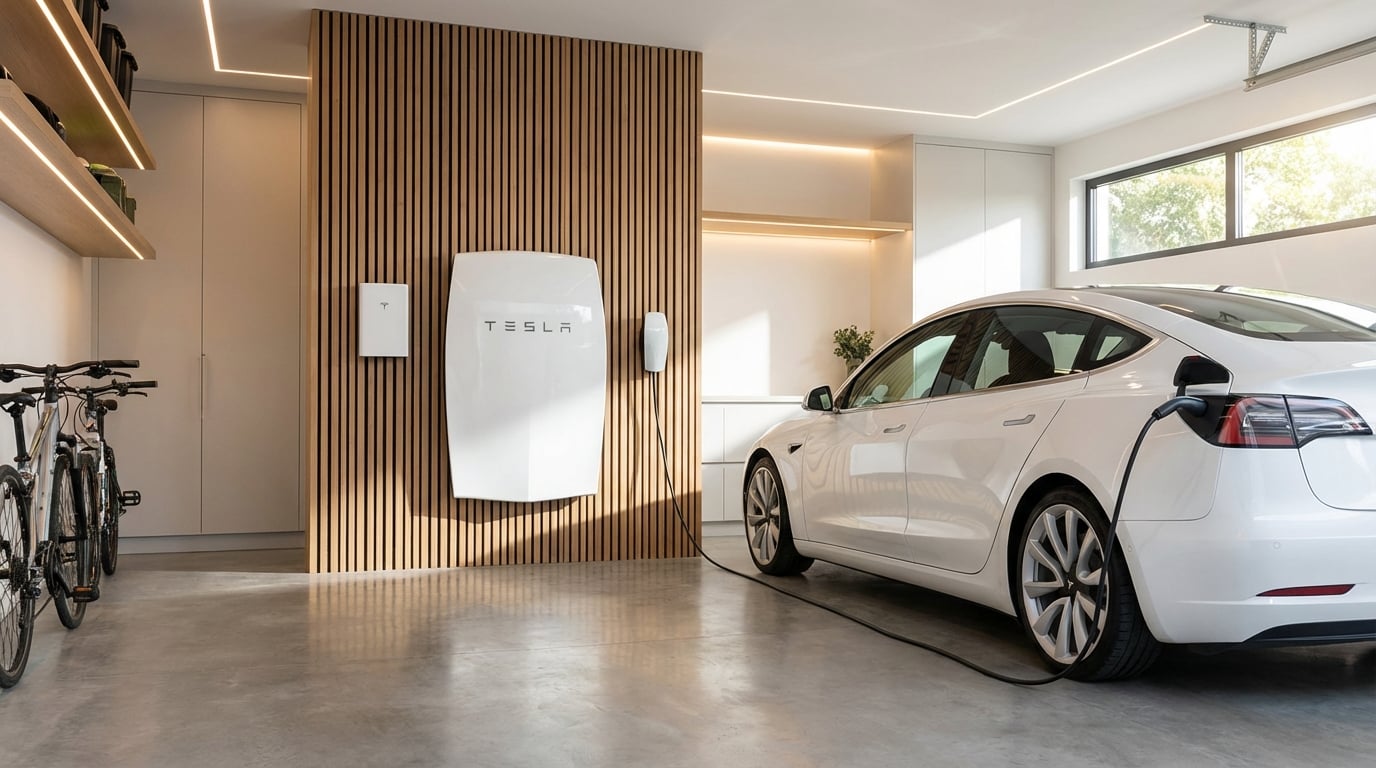
Tesla Powerwall Cost in 2026: Pricing, Installation, and Alternatives
The Tesla Powerwall 3 costs $9,200 for the battery unit itself. With installation, permitting, and electrical work, expect to pay $14,000–18,500 total before incentives. After the 30% federal tax credit, the installed cost drops to $9,800–12,950. The Powerwall 3 stores 13.5 kWh of usable energy and delivers up to 11.5 kW of continuous power — enough to run most homes through a typical evening or back up essential circuits during a multi-hour outage.
Key Takeaways
- Powerwall 3 unit price: $9,200 (battery only, before installation)
- Total installed cost: $14,000–18,500 (single Powerwall; varies by region)
- After 30% tax credit: $9,800–12,950 out of pocket
- Capacity: 13.5 kWh usable storage; 11.5 kW continuous output
- Warranty: 10 years; guaranteed 70% capacity retention
- Multiple units: Up to 4 Powerwalls can be stacked for 54 kWh total storage
What’s in This Guide
Tesla Powerwall Cost Breakdown
| Component | Cost | Details |
|---|---|---|
| Powerwall 3 unit | $9,200 | 13.5 kWh capacity; includes integrated inverter |
| Supporting hardware | $800–1,500 | Gateway, transfer switch, subpanel (if whole-home backup) |
| Installation labor | $2,500–5,000 | 4–8 hours; higher for complex electrical configs or whole-home backup |
| Electrical work | $500–1,500 | Panel modifications, dedicated circuit, conduit runs |
| Permits and inspection | $200–500 | Building and electrical permits; varies by jurisdiction |
| Total installed (1 Powerwall) | $14,000–18,500 | Before 30% federal tax credit |
| After 30% ITC | $9,800–12,950 | Battery qualifies whether paired with solar or standalone |
The Powerwall 3 includes a built-in solar inverter, which is a significant change from the Powerwall 2. If you’re installing solar and a Powerwall together, the integrated inverter can replace a separate solar inverter, potentially saving $1,500–3,000 on your total system cost. This makes the Powerwall 3 particularly cost-effective when installed as part of a new solar system.
Powerwall 3 vs. Powerwall 2
| Specification | Powerwall 3 | Powerwall 2 (discontinued) |
|---|---|---|
| Price (unit only) | $9,200 | $8,000 (was) |
| Usable capacity | 13.5 kWh | 13.5 kWh |
| Continuous power | 11.5 kW | 5 kW |
| Peak power | 20 kW (10 sec) | 7 kW |
| Integrated solar inverter | Yes (11.5 kW) | No |
| Round-trip efficiency | 97.5% | 90% |
| Warranty | 10 years / 70% | 10 years / 70% |
The Powerwall 3’s biggest upgrade is power output — 11.5 kW continuous vs. 5 kW for the Powerwall 2. This means a single Powerwall 3 can run air conditioning, an electric stove, and other high-draw appliances simultaneously during an outage, where a Powerwall 2 struggled with more than basic loads. The integrated inverter and higher efficiency are also meaningful improvements that justify the $1,200 price increase.
Cost for Multiple Powerwalls
| Configuration | Total Storage | Installed Cost | After 30% ITC | Best For |
|---|---|---|---|---|
| 1 Powerwall | 13.5 kWh | $14,000–18,500 | $9,800–12,950 | Self-consumption, partial backup |
| 2 Powerwalls | 27 kWh | $22,000–28,000 | $15,400–19,600 | Whole-home backup (most homes) |
| 3 Powerwalls | 40.5 kWh | $30,000–37,000 | $21,000–25,900 | Large homes, extended outage protection |
| 4 Powerwalls | 54 kWh | $38,000–46,000 | $26,600–32,200 | Off-grid capable, maximum resilience |
Each additional Powerwall costs less to install because the permitting, gateway, and base electrical work are already done. The second unit typically adds $8,000–10,000 to the total (mostly the unit cost plus incremental labor), while the first unit carries all the fixed installation costs. Most homeowners need 1–2 Powerwalls depending on their backup priorities and solar system size.
Tesla Powerwall vs. Competitors
| Battery | Capacity | Continuous Power | Installed Cost | $/kWh Installed |
|---|---|---|---|---|
| Tesla Powerwall 3 | 13.5 kWh | 11.5 kW | $14,000–18,500 | $1,037–1,370 |
| Enphase IQ Battery 5P | 5 kWh (modular) | 3.84 kW per unit | $7,000–9,000/unit | $1,400–1,800 |
| Franklin WH aPower | 13.6 kWh | 10 kW | $13,000–17,000 | $956–1,250 |
| SolarEdge Home Battery | 9.7 kWh | 5 kW | $10,000–14,000 | $1,031–1,443 |
| LG RESU Prime | 16 kWh | 7 kW | $14,000–18,000 | $875–1,125 |
The Powerwall 3’s standout advantage is its power output — 11.5 kW continuous is industry-leading for a single residential battery. This matters most for backup power: it can start and run air conditioning, well pumps, and other high-surge appliances that lower-power batteries struggle with. The integrated solar inverter also gives it a cost advantage in new solar+storage installations.
The Franklin WH aPower is the closest competitor on specs and offers a lower cost per kWh. Enphase batteries are modular (buy in 5 kWh increments) which gives more flexibility but at a higher per-kWh cost. For homeowners prioritizing the Tesla ecosystem and app experience, the Powerwall remains the most polished product.
Is a Tesla Powerwall Worth It?
Worth it if: You live in an area with frequent power outages (2+ per year), have time-of-use electricity rates where you can charge during cheap off-peak hours and discharge during expensive peak hours, live in California under NEM 3.0 where battery storage significantly improves solar economics, or want whole-home backup power without a gas generator.
Less clear value if: You have full retail-rate net metering (the grid acts as free “storage”), rarely experience outages, have flat electricity rates with no time-of-use premium, or are trying to maximize pure financial ROI — the battery adds cost that extends your solar payback period by 2–5 years.
Tax Credits and Incentives for Battery Storage
Federal tax credit (30%): Battery storage qualifies for the full 30% Residential Clean Energy Credit (Section 25D) through 2032. Since the IRA passed in 2022, standalone batteries (not paired with solar) also qualify. The battery must have at least 3 kWh of capacity. A $16,000 installed Powerwall generates a $4,800 credit. For the complete guide, see our solar tax credit guide.
California SGIP: The Self-Generation Incentive Program provides rebates of $150–1,000/kWh for battery storage in California, with higher rates for low-income households and customers in fire-prone areas. A Powerwall 3 can receive $2,000–13,500 in SGIP rebates depending on eligibility. Combined with the federal ITC, California homeowners can reduce Powerwall costs by 40–70%.
State and utility programs: Several states and utilities offer battery-specific incentives: Massachusetts (ConnectedSolutions pays $275/kW per summer season), Vermont (Bring Your Own Device program), Hawaii (battery-ready tariff), and various utilities with demand response programs that pay you for allowing grid discharge during peak events.
Tesla Powerwall Installation Process
Timeline: From order to operational, expect 4–10 weeks. This includes site assessment (1–2 weeks), permitting (2–4 weeks depending on jurisdiction), installation (1 day for the battery, 1–2 days for electrical work), and utility inspection/interconnection (1–2 weeks).
Installation location: The Powerwall 3 can be mounted on an interior or exterior wall, or floor-mounted. It’s rated for temperatures from -4°F to 122°F. Exterior installations in direct sunlight may need a shade structure in hot climates to maintain peak performance. The unit is approximately 43.5” x 24” x 7.6” and weighs 287 lbs — it requires a solid mounting surface.
Electrical requirements: The Powerwall connects to your home’s electrical panel. Whole-home backup requires a transfer switch and may require a critical loads subpanel for homes with older electrical systems. The installer handles all electrical work, permitting, and utility interconnection.
Installer options: Tesla-certified installers (including Tesla’s own installation team), third-party solar companies certified as Tesla Powerwall installers, or independent electricians for the electrical work with Tesla handling the Powerwall-specific commissioning. Getting quotes from 2–3 installers typically saves 10–20% on installation costs.
Compare Solar + Battery Storage Options
Get quotes from certified Tesla Powerwall installers and compare with other battery options.
Frequently Asked Questions
How much does a Tesla Powerwall cost installed?
A Tesla Powerwall 3 costs $14,000–18,500 fully installed, including the $9,200 battery unit, supporting hardware, electrical work, permitting, and labor. After the 30% federal tax credit, the net cost is $9,800–12,950. Installation costs vary by region, electrical complexity, and whether you’re adding the Powerwall to an existing solar system or installing both together (which can reduce total cost by sharing the inverter).
How long can a Tesla Powerwall power a house?
A single Tesla Powerwall 3 (13.5 kWh) powers an average home for 8–12 hours during a typical evening/nighttime period when solar isn’t producing. During an outage, runtime depends on what you’re running: essential loads only (lights, fridge, WiFi, phone charging) can last 24–36 hours, while running AC, cooking appliances, and laundry may drain the battery in 4–6 hours. With solar panels, the Powerwall recharges each day, providing indefinite backup during daylight hours.
Does the Tesla Powerwall qualify for the tax credit?
Yes — the Tesla Powerwall qualifies for the 30% federal Residential Clean Energy Credit whether installed with solar panels or as a standalone battery. The full installed cost (battery, hardware, labor, permitting) is eligible. A $16,000 installed Powerwall generates a $4,800 credit. The 30% rate is available through 2032. For claiming instructions, see our solar tax credit guide.
How long does a Tesla Powerwall battery last?
Tesla warrants the Powerwall for 10 years with a guarantee that it retains at least 70% of its original capacity. In practice, lithium iron phosphate (LFP) batteries like those in the Powerwall 3 typically last 15–20 years before reaching 70% capacity. The expected usable life is 5,000+ charge cycles. After 10–15 years, you’ll still have a functional battery — it just won’t hold as much charge as when it was new.
Is it worth adding a Powerwall to existing solar?
It depends on your utility rate structure and outage frequency. A Powerwall is most valuable with time-of-use rates (store cheap solar, discharge during expensive peaks) or in areas with frequent outages. Under full retail net metering, the grid effectively acts as free storage — the battery won’t save you much money but will provide backup power. In California under NEM 3.0, adding a battery to existing solar often improves financial returns because export credits are so low that self-consumption is much more valuable than exporting.
Tesla Powerwall vs. generator: which is better?
The Powerwall switches on instantly (no startup delay), runs silently, requires no fuel, produces no emissions, and needs minimal maintenance. A whole-home standby generator costs $5,000–15,000 installed, runs on natural gas or propane, and can power your home indefinitely as long as fuel is available. The Powerwall is limited by its battery capacity (13.5 kWh) but recharges from solar. For extended multi-day outages without solar, a generator wins. For typical outages (4–12 hours) and daily energy management, the Powerwall is the better choice.
Related Guides
- Solar Panel Cost Guide — complete pricing for solar systems to pair with battery storage
- Solar Tax Credit 2026 — how to claim 30% on your Powerwall and solar system
- Solar Panel ROI — financial returns with and without battery storage
- How Many Solar Panels Do I Need? — size your solar system to charge your Powerwall