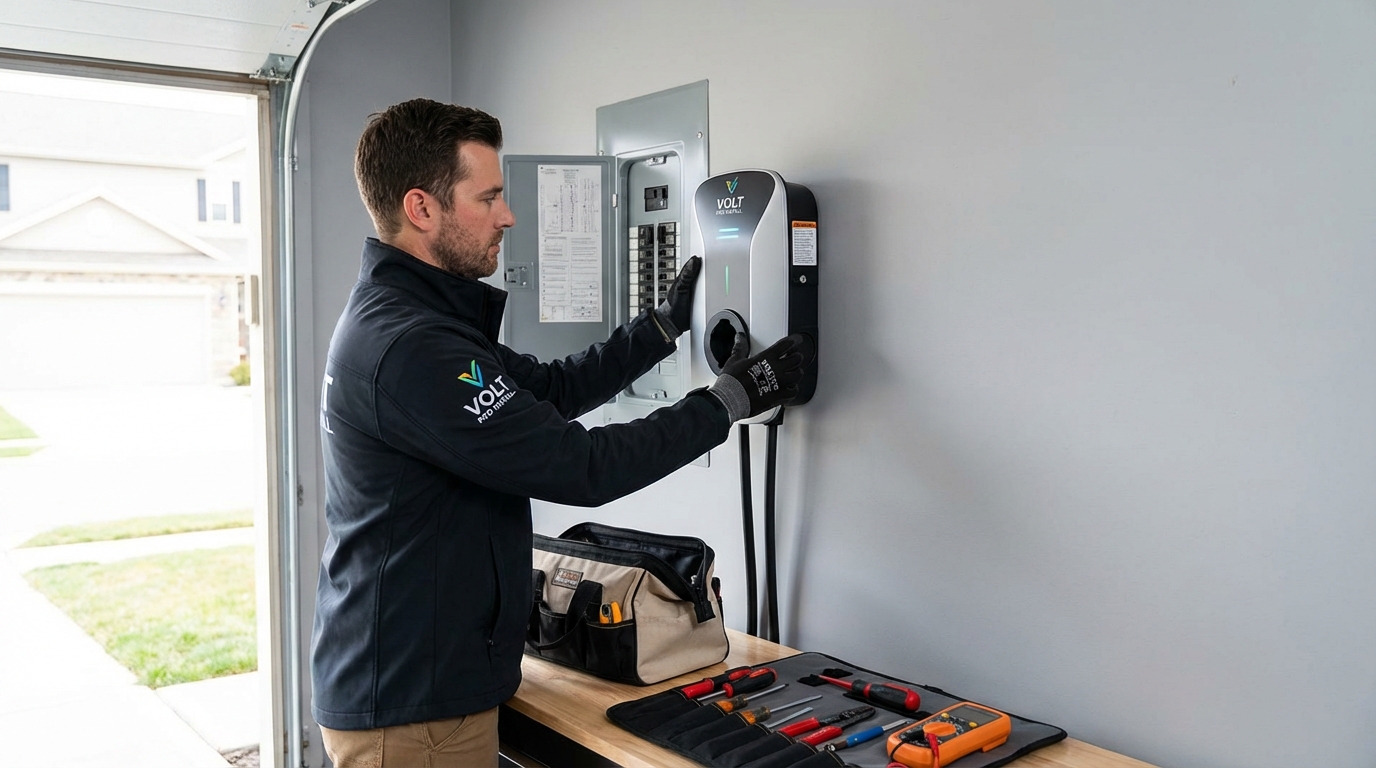
EV Charger Installation Cost in 2026: Home Charging Station Pricing Guide
A home EV charger installation costs $500–$2,500 total for a Level 2 (240V) setup, including the charger unit ($300–$700) and electrician labor ($200–$1,800). The wide range depends primarily on whether your electrical panel can handle the added load — if you need a panel upgrade, add $1,500–$4,000 to the total. Most homeowners with a modern 200-amp panel and an available circuit pay $800–$1,500 all-in for a complete Level 2 home charging setup.
Key Takeaways
- Total installed cost: $500–$2,500 for most homes (charger + installation); $3,000–$6,000+ if a panel upgrade is needed
- Charger unit: $300–$700 for a quality Level 2 charger (40–48 amp); budget options start at $200
- Electrician labor: $200–$1,800 depending on distance from panel, circuit availability, and permit requirements
- Level 2 adds 25–40 miles of range per hour — enough to fully charge most EVs overnight
- Tax credit available: 30% federal tax credit (up to $1,000) under the Inflation Reduction Act
- Biggest cost variable: Electrical panel capacity — a 100-amp panel almost always needs an upgrade ($1,500–$4,000)
What’s in This Guide
- Level 1 vs. Level 2 vs. Level 3: Which Do You Need?
- Complete Cost Breakdown
- Best Home EV Chargers by Price
- What Does Installation Involve?
- Electrical Panel Requirements
- Tax Credits and Rebates
- Can You Install an EV Charger Yourself?
- How Much Does It Cost to Charge an EV at Home?
- Frequently Asked Questions
Level 1 vs. Level 2 vs. Level 3 Charging
EV chargers come in three levels. For home use, you’re choosing between Level 1 and Level 2 — Level 3 (DC fast charging) is commercial-only and costs $50,000+ to install.
| Feature | Level 1 | Level 2 | Level 3 (DC Fast) |
|---|---|---|---|
| Voltage | 120V (standard outlet) | 240V (dryer-type outlet) | 400–900V DC |
| Charging speed | 3–5 miles/hour | 25–40 miles/hour | 150–350 miles/hour |
| Full charge time (60 kWh) | 40–60 hours | 6–10 hours | 20–45 minutes |
| Equipment cost | $0 (comes with EV) | $200–$700 | $15,000–$75,000 |
| Installation cost | $0 | $200–$1,800 | $20,000–$100,000+ |
| Best for | PHEVs, low daily mileage | All home EV charging | Commercial/public locations |
Level 1 (120V) uses the portable charging cord that comes with every EV. You plug it into a standard household outlet — no installation needed. At 3–5 miles of range per hour, it takes 40–60 hours to fully charge a typical EV. Level 1 works for plug-in hybrids or if you drive under 30 miles per day.
Level 2 (240V) is the standard for home EV charging. It uses a dedicated 240V circuit and delivers 25–40 miles of range per hour. A full overnight charge covers 200–320 miles — more than enough for daily use.
EV Charger Installation: Complete Cost Breakdown
| Cost Component | Typical Range | Notes |
|---|---|---|
| Level 2 charger unit | $200–$700 | Hardwired units cost more; plug-in units are portable |
| Electrician labor | $200–$1,000 | Simple install near panel; 1–3 hours at $75–$150/hr |
| 240V circuit materials | $50–$300 | Wire, breaker, outlet, conduit |
| Permit fees | $0–$300 | Required in most jurisdictions |
| Panel upgrade (if needed) | $1,500–$4,000 | 100A to 200A upgrade |
| Trenching (detached garage) | $500–$2,500 | Underground conduit from house to detached garage |
Best-case ($500–$800): Panel has space, charger within 20 feet of panel, plug-in charger. Electrician installs NEMA 14-50 outlet, done in 1–2 hours.
Typical ($1,000–$1,800): Panel has space but charger is 30–50 feet away. Longer wire run, 50-amp circuit, conduit.
Complex ($3,000–$6,000+): 100-amp panel needs upgrade, or detached garage requiring underground conduit.
Best Home EV Chargers by Price
| Charger | Price | Amps | kW Output | Smart Features | Install Type |
|---|---|---|---|---|---|
| Lectron V-Box | $200–$250 | 40A | 9.6 kW | Basic | Plug-in |
| Grizzl-E Classic | $350–$400 | 40A | 9.6 kW | Basic | Hardwired or plug-in |
| ChargePoint Home Flex | $400–$500 | 50A | 12 kW | WiFi, app, scheduling | Both |
| Emporia Smart Level 2 | $400–$450 | 48A | 11.5 kW | WiFi, energy monitoring | Both |
| Tesla Wall Connector | $475 | 48A | 11.5 kW | WiFi, power sharing | Hardwired |
| Wallbox Pulsar Plus | $500–$600 | 48A | 11.5 kW | WiFi, app, solar integration | Both |
All chargers use the J1772 connector standard, compatible with every EV in North America including Tesla (with adapter or native NACS support).
What Does EV Charger Installation Involve?
A standard Level 2 installation takes 2–4 hours:
1. Site assessment (15–30 min): The electrician inspects your electrical panel to verify capacity, checks distance to charger location, and identifies the best wire route.
2. Panel work (30–60 min): Installing a new 40 or 50-amp double-pole breaker. If the panel is full, a tandem breaker or subpanel may be needed.
3. Running wire (30–90 min): 6-gauge copper wire runs from panel to charger location through walls, ceilings, basements, or exterior conduit. Longer runs = more cost.
4. Mounting and connecting (30–45 min): Hardwired chargers get wired directly; plug-in setups get a NEMA 14-50 outlet installed.
5. Testing and permitting: Circuit testing, operation verification, and electrical permit handling.
Electrical Panel: Do You Need an Upgrade?
A Level 2 EV charger draws 40–50 amps — a significant load that many older panels can’t accommodate.
200-amp panel (most homes after 2000): Usually has enough capacity. You need 40–50 amps of available capacity and an open breaker slot.
150-amp panel: May work depending on existing loads. A load management device ($150–$300) can dynamically adjust charger draw when other appliances run.
100-amp panel (homes before 1980): Almost always needs an upgrade ($1,500–$4,000). This involves replacing the panel, meter base, and potentially the service entrance cable.
EV Charger Tax Credits and Rebates
Federal tax credit (Section 30C): 30% of total installation cost, up to $1,000 for residential. A $1,500 install nets $450; a $3,000 install (with panel work) nets the full $1,000. Property must be in an eligible census tract.
State incentives: California’s Clean Vehicle Rebate, New York’s Drive Clean ($500/charger), Colorado’s income tax credit, and many more. State incentives typically stack with federal.
Utility rebates: Many utilities offer $200–$500 for installing smart Level 2 chargers. Some offer discounted overnight EV rates — a separate meter or time-of-use plan can cut charging costs 30–50%.
Can You Install an EV Charger Yourself?
Most homeowners should hire a licensed electrician. Reasons: permits require a licensed electrician in many areas, working in a live 200-amp panel is dangerous, and some charger warranties require professional installation.
Where DIY is fine: If your garage already has a NEMA 14-50 outlet, mounting a plug-in charger is just screwing a bracket to the wall and plugging in — zero electrical work required.
How Much Does It Cost to Charge an EV at Home?
At the national average of $0.17/kWh and average EV efficiency of 3.5 miles/kWh, home charging costs about 5 cents per mile — roughly 60% cheaper than gas at $3.50/gallon in a 30 MPG car ($0.117/mile). Over 12,000 miles/year, that’s $580 in electricity vs. $1,400 in gas — saving $820 annually.
| Vehicle | Battery Size | Full Charge Cost | Monthly (1,000 mi) |
|---|---|---|---|
| Tesla Model 3 LR | 75 kWh | $12.75 | $41 |
| Tesla Model Y | 75 kWh | $12.75 | $45 |
| Chevy Equinox EV | 85 kWh | $14.45 | $49 |
| Ford Mustang Mach-E | 91 kWh | $15.47 | $51 |
| Hyundai Ioniq 5 | 77 kWh | $13.09 | $44 |
| Rivian R1S | 135 kWh | $22.95 | $68 |
Find EV Charger Installers Near You
Compare quotes from licensed electricians experienced with EV charger installations. Read reviews and get your home charging set up.
Frequently Asked Questions
How much does it cost to install an EV charger at home?
A complete Level 2 EV charger installation costs $500–$2,500 for most homes, including the charger ($200–$700) and electrician labor ($200–$1,800). The biggest variable is distance from panel and whether your panel has capacity. If you need a panel upgrade (100 to 200 amps), add $1,500–$4,000.
Can I use my dryer outlet to charge my EV?
Yes, if your dryer uses a NEMA 14-30 or NEMA 14-50 outlet. Buy a portable Level 2 charger with the matching plug and use it when the dryer isn’t running. A NEMA 14-50 adds about 30 miles of range per hour. A smart splitter device ($150–$300) automatically switches between dryer and charger for a permanent solution.
Is a Level 2 charger worth it?
Yes, for almost all EV owners. Level 2 adds 25–40 miles/hour vs. 3–5 from Level 1. Overnight charging covers 200–320 miles. The $800–$1,500 installation typically pays for itself in 1–2 years through avoided public charging fees ($0.30–$0.60/kWh vs. $0.12–$0.17/kWh at home).
How long does it take to charge an EV at home?
With Level 2 (240V), most EVs charge from near-empty to full in 6–10 hours. A 48-amp charger adds 35–40 miles/hour. Most people plug in at 50–70% and wake up to a full charge after 3–5 hours. Level 1 takes 40–60 hours for the same charge.
Do I need a 200-amp panel for an EV charger?
Not always, but it helps. A 200-amp panel usually has enough capacity. A 100-amp panel usually doesn’t and needs an upgrade ($1,500–$4,000) or a load management device. A 150-amp panel might work depending on existing loads. Have an electrician perform a load calculation before committing.
Is there a tax credit for EV charger installation?
Yes. The federal Section 30C credit covers 30% of installation costs up to $1,000 for residential properties in eligible census tracts. Many states offer additional rebates ($200–$500+), and utilities provide incentives for smart chargers. These can stack, covering 40–60% of total cost.
How much does it cost to charge an EV per month?
The average EV costs $40–$70/month to charge at home (1,000 miles at $0.17/kWh average). That’s about 5 cents/mile — 60% cheaper than gas. Costs vary by location: Hawaii is most expensive (~$0.10/mile), Washington and Louisiana cheapest (~$0.03/mile). Time-of-use rates and solar panels reduce costs further.
Related Guides
- Solar Panel Cost Guide 2026 — power your EV with free solar energy
- Federal Solar Tax Credit Guide — maximize renewable energy tax savings
- Solar Panel ROI Calculator — factor in EV charging savings
- How Many Solar Panels Do I Need? — size your system for home + EV