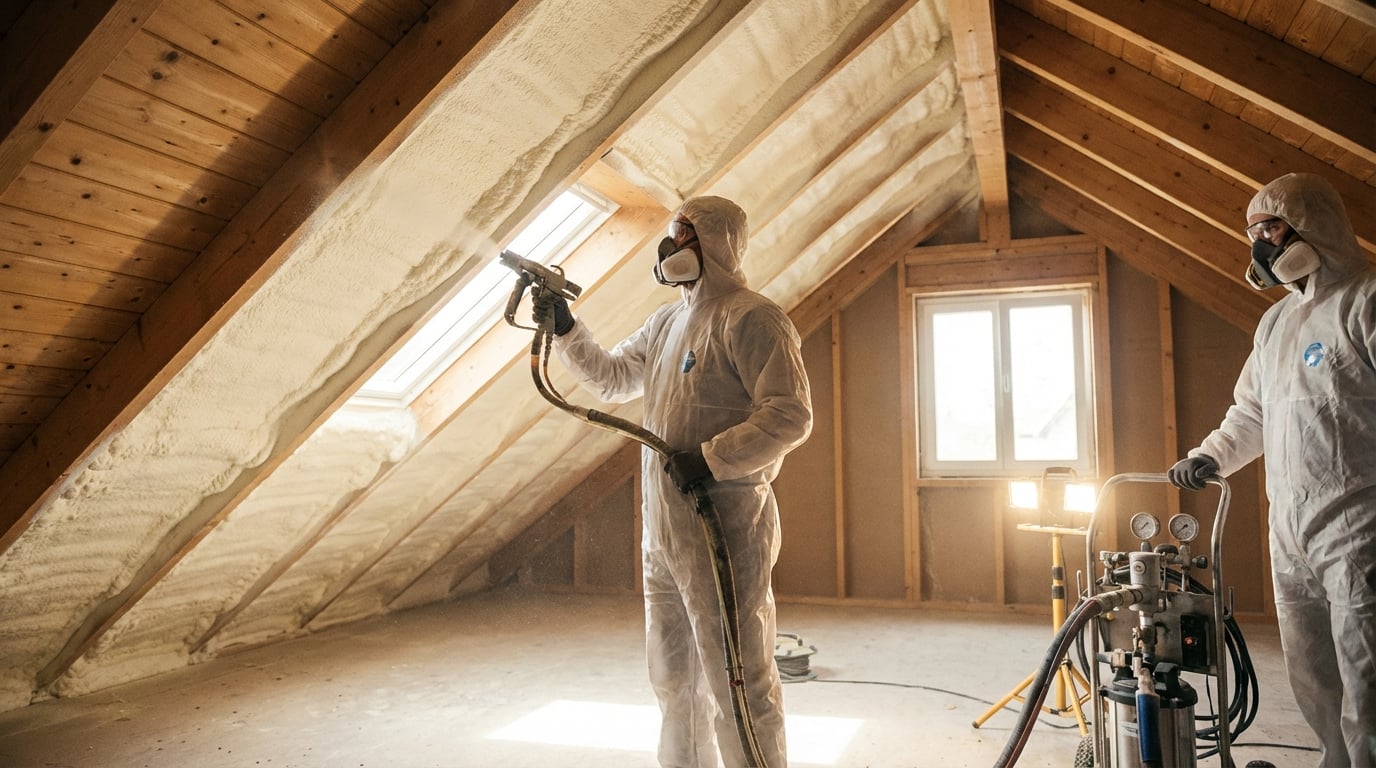
Spray Foam Insulation Cost in 2026 (Open Cell vs. Closed Cell Pricing)
Spray foam insulation costs $1.00–$2.50 per square foot for open cell and $2.00–$4.50 per square foot for closed cell, including professional installation. For a typical 1,500 sq ft attic, expect to pay $1,500–$3,750 for open cell or $3,000–$6,750 for closed cell spray foam. The national average for a whole-home spray foam project is $3,500–$8,000, though costs vary significantly by region, application area, and foam thickness.
Key Takeaways
- Open cell spray foam: $1.00–$2.50/sq ft installed — best for interior walls, attics, and soundproofing; R-value of 3.5–3.7 per inch
- Closed cell spray foam: $2.00–$4.50/sq ft installed — best for basements, crawl spaces, and exterior walls; R-value of 6.0–7.0 per inch
- Average whole-home project: $3,500–$8,000 depending on area, foam type, and thickness
- DIY kits: $0.50–$1.50/sq ft for materials, but professional installation is strongly recommended for large areas
- Energy savings: Spray foam typically reduces heating and cooling costs by 30–50% compared to no insulation, paying for itself in 3–5 years
- Key cost factor: Foam thickness drives total price — attics need 5–10 inches of open cell or 3–4 inches of closed cell
What’s in This Guide
- Cost Per Square Foot Breakdown
- Open Cell vs. Closed Cell: Cost and Performance
- Cost by Area of Home
- Cost by Home Size
- Factors That Affect Spray Foam Cost
- DIY Spray Foam Kits vs. Professional Installation
- Spray Foam vs. Other Insulation Types
- Energy Savings and ROI
- How to Hire a Spray Foam Contractor
- Frequently Asked Questions
Spray Foam Insulation Cost Per Square Foot
Spray foam pricing is quoted per square foot at a specified thickness (usually 1 inch). Since most applications require multiple inches of foam, you need to multiply the per-inch price by the required thickness to get your actual cost. Here’s what the market looks like in 2026:
| Foam Type | Cost Per Sq Ft (1 inch) | R-Value Per Inch | Typical Thickness | Total Cost Per Sq Ft |
|---|---|---|---|---|
| Open Cell | $0.35–$0.65 | R-3.5 to R-3.7 | 3–5.5 inches | $1.00–$3.60 |
| Closed Cell | $1.00–$1.50 | R-6.0 to R-7.0 | 2–3 inches | $2.00–$4.50 |
Open Cell vs. Closed Cell Spray Foam
The choice between open and closed cell foam affects both your cost and your insulation performance. They’re fundamentally different products designed for different applications:
| Feature | Open Cell | Closed Cell |
|---|---|---|
| R-Value per inch | R-3.5 to R-3.7 | R-6.0 to R-7.0 |
| Cost per sq ft (installed) | $1.00–$3.60 | $2.00–$4.50 |
| Moisture barrier | No (vapor permeable) | Yes (Class II vapor retarder at 2″) |
| Air barrier | Yes (at 3.5″) | Yes (at 1″) |
| Structural strength | None | Adds racking strength to walls |
| Density | 0.5 lb/cu ft | 2.0 lb/cu ft |
| Soundproofing | Excellent | Good |
| Best applications | Attics, interior walls, ceilings | Basements, crawl spaces, exterior walls, rim joists |
When to use open cell: Choose open cell when your primary goals are air sealing and thermal insulation in protected spaces — attics (between rafters to create a conditioned attic), interior walls for sound reduction, and ceilings between floors. Open cell costs 40–60% less than closed cell and provides excellent air sealing. The downside is it absorbs moisture, so it shouldn’t be used in below-grade applications or anywhere exposed to bulk water.
When to use closed cell: Choose closed cell for areas that need moisture protection alongside insulation — basement walls, crawl spaces, rim joists, and exterior wall cavities in cold climates. Closed cell also adds structural rigidity (up to 300% increase in racking strength for walls) and achieves the required R-value in less thickness, which matters in tight spaces like 2×4 wall cavities where you can’t fit enough open cell to meet code.
Spray Foam Insulation Cost by Area of Home
| Area | Recommended Type | Typical Thickness | Cost Range |
|---|---|---|---|
| Attic (roof deck) | Open cell | 5–7 inches | $1,500–$4,500 |
| Attic (roof deck) | Closed cell | 3–4 inches | $3,000–$7,500 |
| Exterior walls (new construction) | Closed cell | 2–3 inches | $2,500–$6,000 |
| Basement walls | Closed cell | 2–3 inches | $1,800–$4,500 |
| Crawl space | Closed cell | 2–3 inches | $1,500–$4,000 |
| Rim joists / band joists | Closed cell | 2 inches | $300–$800 |
| Garage (walls + ceiling) | Open or closed cell | 3–5 inches | $1,200–$4,000 |
| Pole barn / metal building | Closed cell | 2–3 inches | $3,000–$10,000+ |
Spray Foam Insulation Cost by Home Size
For a whole-home spray foam project (attic + exterior walls in new construction, or attic-only in an existing home), here’s what to budget:
| Home Size | Attic Only (Open Cell) | Attic Only (Closed Cell) | Whole Home (New Build) |
|---|---|---|---|
| 1,000 sq ft | $1,000–$2,500 | $2,000–$4,500 | $4,000–$9,000 |
| 1,500 sq ft | $1,500–$3,750 | $3,000–$6,750 | $6,000–$13,500 |
| 2,000 sq ft | $2,000–$5,000 | $4,000–$9,000 | $8,000–$18,000 |
| 2,500 sq ft | $2,500–$6,250 | $5,000–$11,250 | $10,000–$22,500 |
| 3,000 sq ft | $3,000–$7,500 | $6,000–$13,500 | $12,000–$27,000 |
Factors That Affect Spray Foam Insulation Cost
Foam Thickness and R-Value Requirements
This is the biggest cost driver. Building codes specify minimum R-values by climate zone — from R-30 in the mild South to R-60 in the frigid North for attics. Open cell foam at R-3.7/inch needs 8 inches to hit R-30, while closed cell at R-6.5/inch needs just 5 inches. More inches means more material and more labor time. Always check your local code requirements before requesting quotes to avoid being upsold unnecessary thickness.
Accessibility and Prep Work
Spraying in open, accessible attic spaces costs 20–30% less than working in tight crawl spaces, cathedral ceilings, or wall cavities. If existing insulation needs removal first (common in retrofit projects), that adds $1.00–$3.00 per square foot to the total. Removing old fiberglass batts is cheaper than removing old blown-in cellulose or existing spray foam.
Regional Labor Costs
Spray foam installation costs vary 20–40% by region. The Northeast and West Coast run 15–25% above national averages. The Southeast and Midwest tend to be 10–20% below. Rural areas may charge travel fees of $200–$500 for the spray rig transportation.
Project Size and Minimum Charges
Most spray foam contractors have a minimum job size of $1,500–$2,500 regardless of actual square footage. A small 200 sq ft rim joist project that would cost $400–$600 in materials and labor may still hit the contractor’s minimum charge. Bundling multiple areas (rim joists + basement walls + attic) into one project reduces your per-square-foot cost because setup and travel costs are spread across more work.
Season and Demand
Spray foam contractors are busiest during spring and fall construction seasons. Winter projects in cold climates can be cheaper (10–15% discounts) but require heated work areas for proper foam curing. Summer can also be slower for residential work as crews focus on commercial projects.
DIY Spray Foam Kits vs. Professional Installation
DIY spray foam kits are available at home improvement stores and online, but they’re a different product class than professional-grade spray foam:
| Factor | DIY Kits | Professional Installation |
|---|---|---|
| Cost per sq ft | $0.50–$1.50 | $1.00–$4.50 |
| R-value consistency | Variable (user-dependent) | Consistent (calibrated equipment) |
| Coverage per kit | 200–600 sq ft at 1 inch | Unlimited |
| Best for | Small areas: rim joists, gaps, cracks | Entire attics, walls, basements |
| Equipment needed | Kit includes gun and hoses | $30,000+ professional spray rig |
| Safety gear needed | Full-face respirator, Tyvek suit, gloves | Provided by contractor |
When DIY makes sense: Rim joists, small gaps around windows/doors, pipe penetrations, and other targeted air-sealing jobs under 200 sq ft. Products like the Touch ‘n Foam kits ($300–$700) or Tiger Foam kits ($400–$900) work well for these applications.
When to hire a professional: Any large area (attic, walls, basement). Professional spray rigs heat the chemicals to precise temperatures and spray at consistent pressures — both critical for proper foam expansion and adhesion. Improperly mixed or applied DIY foam can shrink, crack, or fail to adhere, creating gaps that defeat the purpose of spray foam insulation.
Spray Foam vs. Other Insulation Types
| Insulation Type | Cost/Sq Ft | R-Value/Inch | Air Sealing | Best Application |
|---|---|---|---|---|
| Closed cell spray foam | $2.00–$4.50 | R-6.0–R-7.0 | Excellent | Basements, crawl spaces, walls |
| Open cell spray foam | $1.00–$3.60 | R-3.5–R-3.7 | Excellent | Attics, interior walls |
| Blown-in cellulose | $0.60–$1.50 | R-3.2–R-3.8 | Moderate | Attic floors, wall cavities |
| Blown-in fiberglass | $0.50–$1.20 | R-2.2–R-2.7 | Poor | Attic floors |
| Fiberglass batts | $0.30–$0.80 | R-3.0–R-3.8 | Poor | Wall cavities (new construction) |
| Mineral wool batts | $0.50–$1.20 | R-3.3–R-4.2 | Poor | Fire-rated assemblies, exterior walls |
Spray foam’s biggest advantage over traditional insulation isn’t the R-value — it’s the air sealing. A fiberglass batt with R-19 rating performs at only R-11 to R-14 in real-world conditions because air moves through and around the batts. Spray foam fills every gap, crack, and irregular surface, creating an airtight envelope. This is why spray-foamed homes often use 30–50% less energy than batt-insulated homes, even when both meet the same R-value code requirements on paper.
For a detailed comparison with all insulation types and costs by home size, see our complete attic insulation cost guide.
Spray Foam Insulation Energy Savings and ROI
Spray foam insulation typically delivers the highest energy savings of any insulation type because it combines thermal resistance with near-perfect air sealing. Here’s what the real-world data shows:
Heating savings: 30–50% reduction in heating costs for homes switching from no insulation or degraded batt insulation to spray foam. Homes with existing blown-in insulation see smaller gains (10–25%) since they already had decent thermal resistance.
Cooling savings: 20–35% reduction in cooling costs. Spray foam in the attic roof deck is particularly effective because it brings ductwork inside the conditioned envelope — leaky ducts in a hot attic can waste 20–30% of your HVAC energy.
Payback period: Most spray foam projects pay for themselves in 3–7 years through energy savings alone. Attic projects in extreme climates (very cold or very hot) pay back fastest — often under 4 years. Mild climates see longer payback periods of 5–8 years.
Federal and state incentives can accelerate your payback. The Inflation Reduction Act’s 25C energy efficiency tax credit covers 30% of insulation costs up to $1,200 per year. Many utility companies offer additional rebates of $200–$1,000 for insulation upgrades. Check your local energy rebates and incentives to see what’s available in your area.
How to Hire a Spray Foam Contractor
Spray foam installation requires specialized training and equipment — more so than most insulation types. Here’s how to find a qualified contractor:
Get a detailed, itemised quote. Spray foam pricing varies significantly between contractors. Make sure quotes specify the same foam type, thickness, and R-value so you’re comparing apples to apples.
Verify certifications. Look for contractors certified by the Spray Polyurethane Foam Alliance (SPFA) or with manufacturer-specific training from brands like Demilec, BASF, Lapolla, or Huntsman.
Ask about their equipment. Professional spray rigs cost $30,000–$100,000. Contractors with well-maintained, newer equipment produce more consistent foam.
Check references and insurance. Spray foam gone wrong is expensive to fix — bad foam may need to be physically cut out and replaced. Verify the contractor carries general liability insurance and workers’ compensation.
Find Spray Foam Insulation Contractors Near You
Compare quotes from pre-screened insulation professionals. Read reviews, check certifications, and get the best price.
Frequently Asked Questions
How much does spray foam insulation cost per square foot?
Open cell spray foam costs $0.35–$0.65 per square foot per inch of thickness ($1.00–$3.60/sq ft at typical installed thickness). Closed cell spray foam costs $1.00–$1.50 per square foot per inch ($2.00–$4.50/sq ft installed). These prices include professional installation labor and materials.
Is spray foam insulation worth the cost?
Yes, for most applications. Spray foam costs 2–4x more than fiberglass batts upfront, but it creates an airtight seal that reduces energy bills by 30–50%. Most homeowners recoup the investment in 3–7 years through energy savings alone. Spray foam also increases home resale value, reduces outdoor noise, and prevents moisture-related problems in basements and crawl spaces.
What is the difference between open cell and closed cell spray foam?
Open cell spray foam (R-3.5–R-3.7/inch, $1.00–$3.60/sq ft) is lighter, more flexible, and better for soundproofing. It allows moisture to pass through, so use it in above-grade applications like attics. Closed cell spray foam (R-6.0–R-7.0/inch, $2.00–$4.50/sq ft) is denser, acts as a moisture barrier, and adds structural strength. Use closed cell in basements, crawl spaces, rim joists, and anywhere moisture resistance is needed.
How much does it cost to spray foam a 1,500 square foot attic?
A 1,500 sq ft attic costs $1,500–$3,750 with open cell spray foam (at 5–7 inches) or $3,000–$6,750 with closed cell spray foam (at 3–4 inches). Open cell is the more popular choice for attics because it costs significantly less and provides excellent air sealing.
Can you spray foam insulation yourself?
DIY spray foam kits work for small projects — rim joists, gaps around pipes, and small wall sections under 200 sq ft. For larger areas, professional installation is strongly recommended. Professional spray rigs heat and pressurize the chemicals to exact specifications for proper expansion and adhesion. DIY also requires serious safety equipment including a full-face respirator, protective suit, and chemical-resistant gloves.
How long does spray foam insulation last?
Properly installed spray foam insulation lasts the lifetime of the building — 50+ years with no maintenance needed. Unlike fiberglass batts (which settle and compress) and blown-in cellulose (which settles 15–20% within a few years), spray foam maintains its R-value and air-sealing properties indefinitely once fully cured.
Does spray foam insulation qualify for a tax credit?
Yes. The Inflation Reduction Act’s Section 25C energy efficiency tax credit covers 30% of spray foam insulation costs (materials and installation), up to $1,200 per year. For a $5,000 spray foam project, you’d receive a $1,500 federal tax credit. Many states and utility companies offer additional rebates of $200–$1,000.
What are the disadvantages of spray foam insulation?
The main disadvantages are higher upfront cost (2–4x more than fiberglass), difficulty of removal if repairs are needed, potential for off-gassing during installation (requiring 24–72 hours of vacancy), and the need for professional installation. Closed cell foam also makes future moisture damage harder to detect because it acts as a vapor barrier.
Related Guides
- Attic Insulation Cost Guide 2026 — complete breakdown of all insulation types and costs
- Heat Pump Installation Cost — pair insulation with an efficient HVAC system
- Home Energy Audit Guide — find out where your home is losing energy
- Geothermal Heating Cost — maximize energy savings with ground-source heating