Home Energy Audit Guide: What to Expect, Cost, and DIY Checklist (2026)
A professional home energy audit costs $200–600 and takes 2–4 hours to complete. The auditor uses blower door tests, infrared cameras, and combustion safety checks to find where your home wastes energy — then gives you a prioritized list of upgrades that typically save 5–30% on utility bills. Most audits pay for themselves within the first year through the improvements they identify, and the audit itself qualifies for a $150 federal tax credit under the 25C energy efficiency program.
Key Takeaways
- Professional audit cost: $200–600 (many utilities subsidize or offer free audits)
- Tax credit: $150 federal tax credit for qualified home energy audits (25C)
- Time required: 2–4 hours for professional; 1–2 hours for DIY walkthrough
- Typical savings: 5–30% reduction in energy bills after implementing recommendations
- What’s tested: Air leaks, insulation levels, HVAC efficiency, duct leakage, moisture issues
- Best timing: Before major HVAC upgrades, insulation projects, or home renovations
What’s in This Guide
What Is a Home Energy Audit?
A home energy audit (also called a home energy assessment) is a systematic inspection that identifies how your home uses energy and where it wastes it. Think of it as a physical exam for your house — the auditor diagnoses problems you can’t see, like hidden air leaks, inadequate insulation, and inefficient HVAC operation, then prescribes specific fixes ranked by cost-effectiveness.
There are three levels of home energy assessments:
| Audit Type | Cost | What It Includes | Best For |
|---|---|---|---|
| DIY walkthrough | Free | Visual inspection of air leaks, insulation, thermostat settings | Quick wins and obvious problems |
| Utility-sponsored audit | Free–100 | Basic inspection, some testing, free LED bulbs and low-flow fixtures | Homeowners wanting a no-cost starting point |
| Professional comprehensive audit | $200–600 | Blower door test, infrared imaging, duct leakage test, combustion safety, detailed report | Full diagnosis before major upgrades |
The comprehensive professional audit is what most energy experts recommend. The blower door test and infrared camera reveal problems that are invisible to the naked eye — like air leaking through electrical outlets, recessed lights, or gaps behind baseboards that you’d never find on a visual inspection alone.
How Much Does a Home Energy Audit Cost?
| Audit Component | Cost Range | Details |
|---|---|---|
| Standard professional audit | $200–400 | Blower door test, visual inspection, basic report |
| Comprehensive audit with IR | $300–600 | Adds infrared thermal imaging, duct leakage testing, detailed energy model |
| Duct leakage test (add-on) | $75–150 | Measures air loss through ductwork; sometimes included |
| Combustion safety test | Included | Tests gas appliances for carbon monoxide; standard in comprehensive audits |
| Federal tax credit (25C) | –$150 | Covers up to $150 of audit cost; must meet DOE requirements |
After the $150 tax credit, a comprehensive home energy audit effectively costs $50–450. Many utility companies subsidize audits further or offer them free — check with your electric and gas providers before paying full price. Some states (Massachusetts, New York, Oregon, Connecticut) offer fully subsidized audits through their energy efficiency programs.
What Happens During a Professional Energy Assessment
A comprehensive home energy assessment follows a structured process that takes 2–4 hours depending on your home’s size. Here’s exactly what to expect:
1. Utility bill review (15 minutes). The auditor starts by analyzing 12 months of your electricity and gas bills to establish baseline usage patterns. They’re looking for seasonal spikes, unusually high consumption relative to home size, and changes that might indicate equipment problems. Bring your bills or grant online account access before the visit.
2. Visual inspection (30–45 minutes). Room-by-room walkthrough checking insulation levels in the attic, basement, and walls. The auditor inspects weatherstripping on doors and windows, looks for obvious air gaps around pipes and wiring penetrations, checks HVAC equipment age and condition, and evaluates lighting and appliance efficiency.
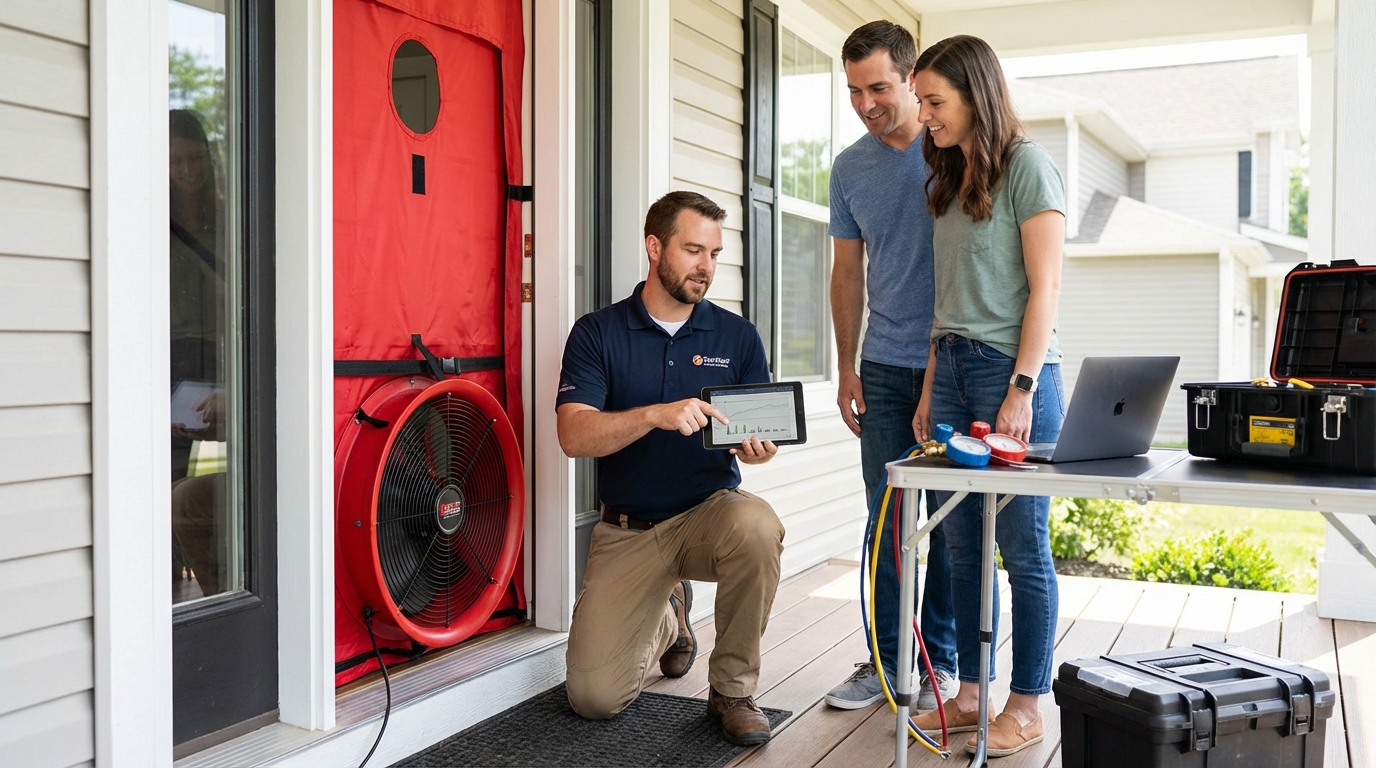
3. Blower door test (20–30 minutes). This is the most important diagnostic test. The auditor mounts a calibrated fan in your front door and depressurizes the house to 50 Pascals (roughly equivalent to a 20 mph wind hitting all sides simultaneously). This exaggerates every air leak so they can be found and measured. The result is expressed in ACH50 (air changes per hour at 50 Pascals) — most existing homes score 5–15 ACH50, while a tight home is under 3 ACH50.
4. Infrared thermal imaging (20–30 minutes). While the house is depressurized, the auditor uses an infrared camera to photograph walls, ceilings, and floors. Cold air streaming through leaks shows up as blue or purple streaks against the warmer orange/yellow surfaces. This reveals insulation gaps, missing insulation in walls, and air leaks you’d never find visually — like gaps at the top plates of interior walls or behind electrical panels.
5. Duct leakage testing (15–20 minutes). A separate fan pressurizes just the duct system to measure how much conditioned air escapes through duct joints, connections, and gaps before reaching your rooms. Typical older homes lose 20–40% of HVAC output through duct leaks — sealing these is often the single most cost-effective upgrade.
6. Combustion safety testing (10–15 minutes). If you have gas appliances (furnace, water heater, stove), the auditor tests for proper venting and checks carbon monoxide levels. This is a safety check, not just an efficiency check — backdrafting gas appliances can introduce CO into your living space.
7. Report and recommendations (delivered within 1–3 days). You receive a detailed report including your home’s air leakage rate, insulation levels by location, HVAC efficiency, and a prioritized list of recommended upgrades with estimated costs and energy savings. Good reports include projected payback periods for each improvement so you can budget strategically.
DIY Home Energy Audit Checklist
You can catch many common energy problems with a free self-inspection. This checklist covers the same areas a professional examines, minus the specialized equipment. Walk through your home with this list and note every issue you find:
| Area | What to Check | What to Look For |
|---|---|---|
| Attic | Insulation depth and coverage | Less than 10–14 inches of insulation; gaps around pipes, wires, light fixtures |
| Attic hatch | Weatherstripping and insulation | Daylight visible around edges; no insulation on the hatch door itself |
| Windows | Drafts, condensation, seal condition | Feel for drafts on windy days; fog between double-pane glass (seal failure) |
| Exterior doors | Weatherstripping and sweeps | Daylight visible around door frame; worn or missing weatherstripping |
| Electrical outlets | Air leaks on exterior walls | Hold a tissue near outlets on windy days — movement indicates air leaks |
| Basement/crawlspace | Rim joist insulation, moisture | Uninsulated rim joists; moisture on walls; musty smell |
| HVAC system | Age, filter condition, duct connections | Equipment older than 15 years; dirty filter; visible duct gaps or disconnections |
| Water heater | Age, temperature setting, insulation | Over 10 years old; set above 120°F; no insulation blanket on older tanks |
| Lighting | Bulb types | Count incandescent or CFL bulbs still in use (switch to LED) |
| Thermostat | Type and programming | Manual thermostat with no schedule; setbacks not programmed |
Common Audit Findings and What They Cost to Fix
| Finding | How Common | Fix Cost | Annual Savings | Payback |
|---|---|---|---|---|
| Air leaks (attic bypasses, gaps) | 95% of homes | $500–2,500 | $200–600 | 1–4 years |
| Insufficient attic insulation | 80% of homes | $1,500–3,500 | $200–500 | 3–7 years |
| Duct leaks | 75% of homes | $500–1,500 | $150–400 | 1–4 years |
| Old HVAC system (15+ years) | 40% of homes | $4,000–12,000 | $300–900 | 5–12 years |
| No smart thermostat | 55% of homes | $150–300 | $50–150 | 1–3 years |
| Uninsulated basement rim joists | 70% of homes | $300–800 | $100–250 | 1–4 years |
| Single-pane or failed windows | 25% of homes | $300–1,000/window | $100–300 total | 10–20 years |
The highest-ROI upgrades are almost always air sealing and insulation — they’re relatively inexpensive and produce immediate, measurable savings. Most auditors recommend tackling air sealing first because insulation works best when air isn’t bypassing it. A common and cost-effective sequence: air seal the attic floor and basement rim joists first ($500–1,500), then add attic insulation ($1,500–3,000), then address duct sealing ($500–1,500). These three projects together typically save 15–25% on heating and cooling costs.
HVAC replacement has the highest absolute cost but the longest payback. However, if your system is 15+ years old and you’re already planning to replace it, the audit data helps you right-size the new system. A tighter, better-insulated home may need a smaller (and cheaper) heat pump or furnace than what’s currently installed. For help choosing between heating systems, see our heat pump vs. furnace comparison.
When to Get a Home Energy Audit
Before a major HVAC upgrade. If you’re replacing your furnace, AC, or switching to a heat pump, an audit first ensures the new system is properly sized for your actual heating and cooling loads — not oversized based on your leaky, under-insulated current condition. Tightening the building envelope first can let you install a smaller, less expensive HVAC system.
When rooms are uncomfortable. Hot or cold spots, drafty rooms, and temperature differences between floors are symptoms of air leaks, insulation gaps, or duct problems. An audit pinpoints exactly where and why, so you fix the root cause rather than guessing.
When energy bills seem too high. If your bills are significantly higher than neighbors with similar-sized homes, an audit reveals what’s driving the excess consumption. The average American household spends $2,000–3,000/year on energy — if you’re well above that for your home size and climate, there are almost certainly cost-effective improvements available.
Before adding insulation. Spraying spray foam insulation or blowing cellulose into your attic without first air-sealing is a common and expensive mistake. The audit identifies air bypasses that need to be sealed before insulation goes in — otherwise you’re insulating around the leaks rather than stopping them.
After buying an older home. Homes built before 2000 rarely meet current energy codes. An audit within the first year of ownership helps you prioritize improvements and budget for them while you’re already in renovation mode.
How to Find a Qualified Energy Auditor
Look for BPI or RESNET certification. The Building Performance Institute (BPI) and Residential Energy Services Network (RESNET) are the two main certification bodies. BPI Building Analysts and RESNET HERS Raters both receive training in diagnostic testing, building science, and combustion safety. Either certification means the auditor has demonstrated competency with blower doors, infrared cameras, and duct testing equipment.
Check with your utility first. Many electric and gas utilities offer subsidized or free energy audits through their demand-side management programs. These audits are typically performed by BPI-certified contractors under contract with the utility. The trade-off: utility audits sometimes focus more on lighting and appliance rebates than on comprehensive building envelope testing.
Get the full package. When comparing auditors, confirm that the price includes a blower door test, infrared scan, duct leakage test (if you have ducts), combustion safety testing (if you have gas), and a written report with prioritized recommendations and cost estimates. Some low-cost audits skip the infrared scan or duct testing — these are the most valuable diagnostic tools, so don’t settle for a visual-only inspection at professional prices.
Improve Your Home’s Energy Efficiency
Find certified energy auditors and HVAC contractors in your area. Compare ratings, services, and pricing.
Frequently Asked Questions
How much does a home energy audit cost?
A professional home energy audit costs $200–600, with the national average around $350 for a comprehensive assessment including blower door test, infrared imaging, and duct leakage testing. After the $150 federal tax credit, the effective cost is $50–450. Many utility companies offer free or subsidized audits — check with your electric and gas providers first. States like Massachusetts, New York, and Connecticut offer fully funded audits through their energy efficiency programs.
Is a home energy audit worth it?
Yes — a home energy audit typically identifies $300–1,500 in annual energy savings through improvements that cost $1,000–5,000 to implement. The audit itself costs $200–600 (effectively $50–450 after the tax credit) and pays for itself within the first year through the savings it identifies. Beyond energy savings, audits often uncover comfort issues (drafty rooms, uneven temperatures) and safety problems (carbon monoxide risks from gas appliances) that have value beyond the utility bill.
What does a home energy audit include?
A comprehensive home energy audit includes a blower door test (measures total air leakage), infrared thermal imaging (reveals insulation gaps and hidden air leaks), duct leakage testing (measures conditioned air lost through ductwork), combustion safety testing (checks gas appliances for carbon monoxide), visual inspection of insulation levels, and a detailed report with prioritized upgrade recommendations and estimated costs and savings. The full process takes 2–4 hours.
Can I do my own home energy audit?
You can perform a basic DIY home energy audit by checking for visible air leaks around windows and doors, inspecting attic insulation depth, examining weatherstripping condition, and reviewing your utility bills for unusual patterns. However, a DIY audit can’t replicate the blower door test (which measures actual air leakage), infrared thermal imaging (which reveals hidden insulation gaps), or duct leakage testing. For homes with high energy bills or comfort issues, the professional audit is worth the $200–600 investment.
Is there a tax credit for home energy audits?
Yes — the federal 25C Energy Efficient Home Improvement Credit includes a $150 tax credit for qualified home energy audits. The audit must be conducted by a certified home energy auditor (BPI or RESNET certified) and produce a written report identifying energy efficiency improvements. This credit is available annually through 2032 and is separate from the $2,000 heat pump credit and other 25C credits, so it doesn’t reduce your limit for equipment upgrades.
How long does a home energy audit take?
A comprehensive professional home energy audit takes 2–4 hours on-site, depending on home size and complexity. Larger homes (3,000+ sq ft) and homes with multiple HVAC systems or complex layouts take longer. You’ll receive the written report with recommendations within 1–3 business days after the visit. A basic utility-sponsored audit typically takes 1–2 hours and provides results on the spot.
What should I do before a home energy audit?
Before your home energy audit, gather 12 months of electricity and gas bills (or grant the auditor online access to your utility accounts). Clear access to your attic hatch, basement, and all HVAC equipment including the furnace, water heater, and air handler. Make a list of comfort complaints (drafty rooms, hot/cold spots, humidity problems) so the auditor can focus on those areas. Close all windows and exterior doors on the day of the audit, as the blower door test requires a sealed building envelope.
Related Guides
- Heat Pump Installation Cost — complete pricing guide for upgrading your HVAC system
- Heat Pump vs. Furnace — compare heating systems before your next HVAC upgrade
- Spray Foam Insulation Cost — insulation pricing and ROI for improving your building envelope
- Geothermal Heating Cost — ground-source heat pump costs and long-term savings