Geothermal Heating and Cooling Cost in 2026 (Full Installation Pricing)
A geothermal heat pump system costs $18,000–$35,000 to install before incentives, with the national average around $25,000 for a 3-ton residential system. After the 30% federal tax credit (worth $5,400–$10,500), most homeowners pay $12,600–$24,500 out of pocket. The ground loop (the buried pipe network that exchanges heat with the earth) accounts for roughly half the total cost, with the heat pump unit and indoor installation making up the rest.
Key Takeaways
- Total installed cost: $18,000–$35,000 before tax credits; $12,600–$24,500 after the 30% federal credit
- Ground loop cost: $8,000–$18,000 (vertical loops cost more than horizontal)
- Heat pump unit + installation: $8,000–$17,000 including ductwork modifications
- Operating cost: 30–60% less than conventional HVAC — typical savings of $1,000–$2,500/year
- Payback period: 5–10 years depending on your current heating fuel and local electricity rates
- System lifespan: 20–25 years for the heat pump, 50+ years for the ground loop
- Tax credit: 30% federal Investment Tax Credit (ITC) through 2032 — no cap on residential systems
What’s in This Guide
How Geothermal Heating and Cooling Works
A geothermal system (also called a ground-source heat pump) doesn’t generate heat — it moves it. Below 6–10 feet underground, the earth maintains a constant temperature of 45–75°F year-round, regardless of the air temperature above. A geothermal system circulates water or an antifreeze solution through buried pipes (the ground loop), absorbing the earth’s heat in winter and depositing excess heat back into the ground in summer.
This is fundamentally different from a furnace (which burns fuel to create heat) or a conventional air-source heat pump (which extracts heat from cold outdoor air, becoming less efficient as temperatures drop). Because the ground temperature is always moderate, geothermal systems operate at 300–500% efficiency — meaning they produce 3 to 5 units of heating energy for every 1 unit of electricity consumed. A gas furnace, by comparison, maxes out at 98% efficiency.
The same system provides both heating and cooling by reversing the heat flow direction. In summer, it extracts heat from your home and deposits it into the cooler ground — the opposite of winter operation. Many systems also include a desuperheater that captures waste heat to preheat your domestic hot water, reducing water heating bills by 30–50%.
Geothermal System Cost Breakdown
| Component | Cost Range | Details |
|---|---|---|
| Ground loop installation | $8,000–$18,000 | Drilling/excavation, piping, antifreeze, connections |
| Heat pump unit | $3,500–$8,000 | 2–5 ton capacity; brands include ClimateMaster, WaterFurnace, Carrier |
| Indoor installation labor | $3,000–$6,000 | HVAC connection, ductwork modifications, thermostat, controls |
| Desuperheater (optional) | $1,500–$3,000 | Preheats domestic hot water using waste heat |
| Permits and engineering | $500–$2,000 | Well permits, load calculations, system design |
| Total before incentives | $18,000–$35,000 | National average: ~$25,000 for 3-ton system |
| After 30% federal tax credit | $12,600–$24,500 | Credit applies to entire installation including ground loop |
Ground Loop Types and Costs
The ground loop is the most expensive and permanent part of a geothermal system. Four loop configurations are available, each suited to different property types:
| Loop Type | Cost | Land Needed | Best For |
|---|---|---|---|
| Horizontal | $8,000–$15,000 | 0.25–0.5 acres | Large yards, rural properties, new construction |
| Vertical | $12,000–$22,000 | Minimal | Small lots, suburban homes, rocky soil |
| Pond/lake | $6,000–$12,000 | Nearby water body | Properties adjacent to a pond, lake, or large stream |
| Open loop (well water) | $6,000–$14,000 | Minimal | Properties with adequate well water supply and discharge |
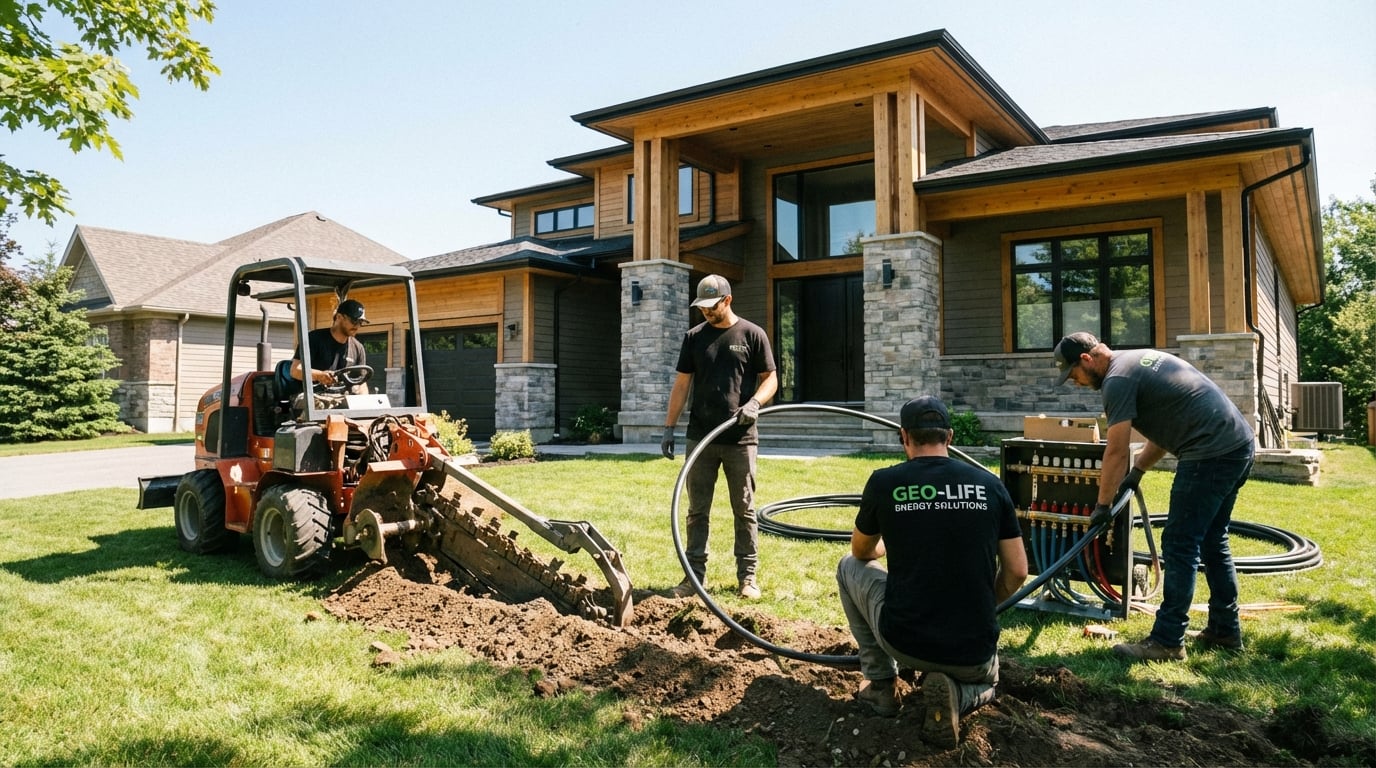
Horizontal loops are the most affordable option. Trenches are dug 4–6 feet deep across your yard and piping is laid in them before backfilling. A typical 3-ton system needs 400–600 feet of trench. The downside: you need a large, accessible yard with no underground utilities, and the excavation temporarily destroys your landscaping.
Vertical loops are the most common choice for existing homes in suburban areas. Holes are drilled 150–400 feet deep (using the same equipment that drills water wells), and piping is inserted into the boreholes. A 3-ton system typically needs 3–5 boreholes spaced 15–20 feet apart. Vertical loops cost more due to drilling costs ($15–$30 per foot of depth) but require very little yard space.
Pond/lake loops are the cheapest to install when available. Coiled piping is submerged in a nearby body of water at least 8 feet deep. The water provides excellent heat exchange, but you need a suitable water body within 200 feet of the house and typically need a permit.
Open loop systems use well water pumped directly through the heat pump, then discharged to a second well, pond, or drainage system. These are highly efficient but require adequate groundwater supply and may need permits for water discharge.
Geothermal Cost by Home Size
| Home Size | System Size | Cost Before Credits | After 30% Tax Credit |
|---|---|---|---|
| 1,000–1,500 sq ft | 2 ton | $15,000–$25,000 | $10,500–$17,500 |
| 1,500–2,000 sq ft | 3 ton | $18,000–$30,000 | $12,600–$21,000 |
| 2,000–2,500 sq ft | 3.5–4 ton | $22,000–$35,000 | $15,400–$24,500 |
| 2,500–3,500 sq ft | 4–5 ton | $25,000–$42,000 | $17,500–$29,400 |
| 3,500+ sq ft | 5–6+ ton | $30,000–$50,000+ | $21,000–$35,000+ |
Annual Operating Costs: Geothermal vs. Other Systems
| Heating System | Annual Heating Cost | Annual Cooling Cost | Total HVAC Cost |
|---|---|---|---|
| Geothermal heat pump | $500–$900 | $200–$400 | $700–$1,300 |
| Air-source heat pump | $700–$1,400 | $300–$600 | $1,000–$2,000 |
| Natural gas furnace + AC | $800–$1,600 | $400–$800 | $1,200–$2,400 |
| Oil furnace + AC | $1,500–$3,000 | $400–$800 | $1,900–$3,800 |
| Propane furnace + AC | $1,200–$2,500 | $400–$800 | $1,600–$3,300 |
| Electric resistance + AC | $2,000–$4,000 | $400–$800 | $2,400–$4,800 |
Geothermal delivers the biggest savings for homes currently heating with oil, propane, or electric resistance. Replacing a propane furnace with geothermal saves $900–$2,000 per year; replacing electric baseboard saves $1,700–$3,500 per year. Homes with natural gas see smaller savings ($500–$1,100/year) because gas is relatively cheap — but geothermal still wins on total cost over its lifespan.
Geothermal Tax Credits and Incentives
Federal Investment Tax Credit (ITC): 30% of the total installed cost with no dollar cap. This covers everything — ground loop, heat pump, ductwork, desuperheater, and all labor. Available through 2032 at 30%, then steps down to 26% (2033) and 22% (2034). Unlike the $2,000-capped air-source heat pump credit, the geothermal credit has no maximum, making it far more valuable for expensive installations.
State incentives: Many states offer additional tax credits, rebates, or property tax exemptions for geothermal. New York’s NYSERDA offers up to $4,000 for geothermal heat pumps. Minnesota, Indiana, and several other states have geothermal-specific incentives worth $1,000–$5,000.
Utility rebates: Some electric utilities offer $500–$2,500 rebates for geothermal installations because these systems reduce peak demand on the grid (they’re most efficient when the grid is most stressed — summer afternoons and winter mornings).
Property tax exemptions: Several states exempt the added home value from geothermal systems from property tax assessments. Since geothermal adds an estimated 3–5% to home value, this exemption can save $200–$800/year in property taxes.
Geothermal ROI and Payback Period
Your payback period depends primarily on what you’re replacing and your local energy costs:
Replacing oil heat: 4–7 year payback. Oil is expensive ($4.00–$5.50/gallon) and volatile. Geothermal savings of $1,500–$2,500/year make this the fastest payback scenario.
Replacing propane: 5–8 year payback. Propane ($2.50–$4.00/gallon) in cold climates means high heating bills that geothermal dramatically reduces.
Replacing electric resistance: 5–8 year payback. Electric baseboard or space heaters are the most expensive way to heat a home. Geothermal’s 300–500% efficiency vs. electric resistance’s 100% efficiency creates massive savings.
Replacing natural gas: 8–12 year payback. Natural gas is cheap ($1.00–$1.50/therm), so annual savings are smaller ($500–$1,100). The payback is longer but you still come out ahead over the system’s 20–25 year lifespan.
Replacing air-source heat pump: 10–15 year payback. Air-source heat pumps are already efficient, so the incremental savings from geothermal are smaller. This is the weakest financial case for geothermal, though it still makes sense in very cold climates where air-source performance degrades significantly.
Pros and Cons of Geothermal Systems
| Advantages | Disadvantages |
|---|---|
| 30–60% lower operating costs than conventional HVAC | High upfront cost ($18,000–$35,000) |
| Heating and cooling in one system + hot water assist | Ground loop installation disrupts landscaping |
| 50+ year ground loop lifespan | Requires adequate yard space or drilling access |
| No outdoor unit — quiet, no aesthetic impact | Fewer qualified installers vs. conventional HVAC |
| Consistent performance in all climates and temperatures | Longer payback period than air-source heat pumps |
| 30% uncapped federal tax credit | Repair costs higher if ground loop develops a leak |
| Adds 3–5% to home resale value | Not ideal for rental properties (payback too long) |
Find Geothermal Installers Near You
Compare quotes from certified geothermal contractors. Read reviews, verify certifications, and get the best price for your system.
Frequently Asked Questions
How much does a geothermal system cost for a 2,000 sq ft house?
A geothermal system for a 2,000 sq ft home typically costs $20,000–$32,000 before incentives, depending on loop type and local drilling costs. A 3-ton system with vertical loops averages $25,000–$30,000. After the 30% federal tax credit, the net cost drops to $14,000–$22,400. Horizontal loops in areas with adequate yard space can bring costs down to $18,000–$25,000 before credits.
Is geothermal heating worth the cost?
Geothermal is worth the cost for homeowners who plan to stay in their home 7+ years and currently heat with oil, propane, electric resistance, or expensive natural gas. Annual savings of $1,000–$2,500 typically pay back the investment in 5–10 years, after which you enjoy decades of reduced energy bills. The 30% uncapped federal tax credit significantly improves the economics. Geothermal is less compelling for homes with cheap natural gas or those planning to move within 5 years.
How long does a geothermal system last?
The ground loop lasts 50+ years — essentially the lifetime of the building. The indoor heat pump unit lasts 20–25 years with regular maintenance (annual filter changes and periodic refrigerant checks). When the heat pump needs replacement, you only replace the indoor unit ($5,000–$10,000), not the ground loop. This makes the second and third heat pump replacements much cheaper than the original installation, extending the system’s useful life to 50+ years total.
What are the disadvantages of geothermal heating?
The main disadvantages are high upfront cost ($18,000–$35,000 before credits), yard disruption during ground loop installation (especially horizontal loops), limited installer availability compared to conventional HVAC, and a longer payback period than air-source heat pumps. Ground loop repairs, while rare, are expensive because they require excavation. Geothermal also isn’t practical for all properties — apartments, homes on very small lots, or areas with unsuitable soil conditions may not be candidates.
How does the 30% tax credit work for geothermal?
The federal Investment Tax Credit (ITC) for geothermal covers 30% of the total installed cost — including the ground loop, heat pump, ductwork, and all labor — with no dollar cap. A $25,000 installation yields a $7,500 tax credit. The credit reduces your federal tax liability dollar-for-dollar. If you don’t owe enough in taxes in one year, the unused credit carries forward to future tax years. The 30% rate is available through 2032, then drops to 26% (2033) and 22% (2034).
Does geothermal work in cold climates?
Yes — and that’s one of geothermal’s biggest advantages over air-source heat pumps. Ground temperature below the frost line stays at 45–55°F even when air temperatures drop to -20°F. This means geothermal systems maintain 300–400% efficiency in the coldest weather, while air-source heat pumps lose significant efficiency below 25°F and may need backup electric resistance heat. States like Minnesota, Wisconsin, and Maine are among the strongest markets for geothermal precisely because the savings vs. conventional heating are greatest in cold climates.
Geothermal vs. air-source heat pump: which is better?
Geothermal costs 2–3x more upfront but operates 30–50% more efficiently and lasts significantly longer. Air-source heat pumps ($4,000–$12,000 installed) make more financial sense for moderate climates, shorter ownership timelines, or smaller budgets. Geothermal wins in very cold climates (where air-source performance drops), for homeowners who’ll stay 10+ years, and when replacing expensive fuel (oil, propane). The 30% uncapped geothermal tax credit vs. the $2,000-capped air-source credit narrows the cost gap significantly.
Related Guides
- Heat Pump Installation Cost Guide — compare air-source vs. geothermal economics
- Heat Pump vs. Furnace — which heating system is right for your climate?
- Home Energy Audit Guide — identify efficiency upgrades before installing geothermal
- Attic Insulation Cost — reduce your heating load before sizing a geothermal system