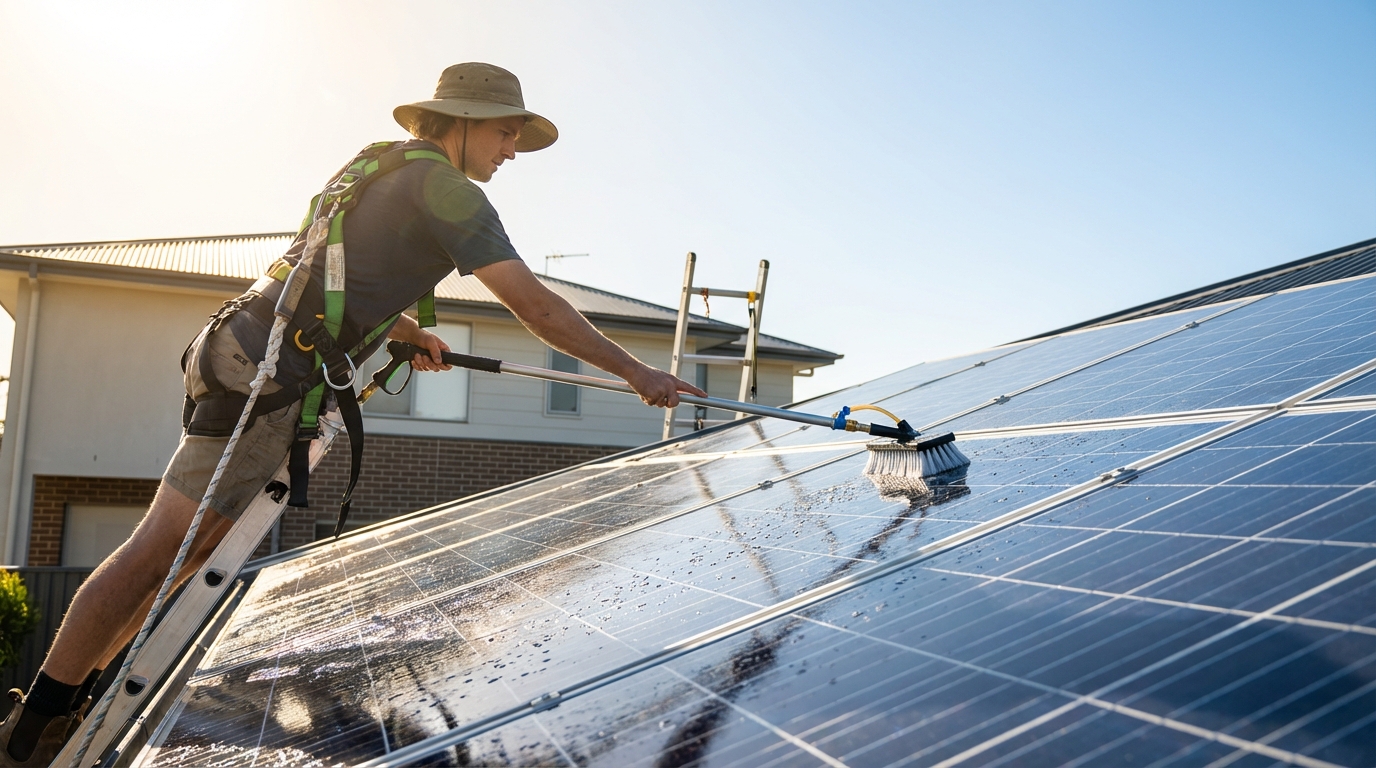
How to Clean Solar Panels (Without Damaging Them)
Clean solar panels with a garden hose and soft brush using plain water or a diluted mild soap — never use pressure washers, abrasive cleaners, or scrub on dry panels. Most residential systems need cleaning 1–2 times per year, and dirty panels lose 5–25% of their energy output. You can safely clean rooftop panels yourself for under $30 in supplies, or hire a professional service for $150–$350.
Key Takeaways
- Best cleaning method: Garden hose + soft-bristle brush + plain water (or 1:10 dish soap mix)
- Never use: Pressure washers, abrasive pads, ammonia-based cleaners, or hard/mineral-heavy water
- Cleaning frequency: 1–2 times per year for most locations; quarterly if near dusty roads, farms, or heavy tree cover
- Energy gain: Cleaning typically restores 5–15% of lost output; heavily soiled panels can recover up to 25%
- Professional cost: $150–$350 for a standard residential system (20–30 panels)
- Best time to clean: Early morning, late afternoon, or on an overcast day — never when panels are hot
What’s in This Guide
- What You’ll Need
- Step-by-Step Cleaning Process
- Cleaning Panels on Your Roof Safely
- How to Clean Panels from the Ground
- What NOT to Do When Cleaning Solar Panels
- How Often Should You Clean Solar Panels?
- Solar Panel Cleaning Cost: DIY vs. Professional
- Does Cleaning Solar Panels Actually Make a Difference?
- How to Clean Snow Off Solar Panels
- Frequently Asked Questions
What You’ll Need to Clean Solar Panels
The good news: you probably already own most of what’s needed. Solar panel glass is tempered and coated with an anti-reflective layer — treat it like a car windshield rather than a kitchen countertop.
| Item | Purpose | Cost |
|---|---|---|
| Garden hose with spray nozzle | Rinsing — does 80% of the work | Already owned |
| Soft-bristle brush or squeegee (with extension pole) | Loosening stuck-on grime, bird droppings | $15–$30 |
| Bucket of water + mild dish soap (optional) | Cutting through grease or heavy pollen | $1–$3 |
| Extension pole (6–24 ft telescoping) | Reaching rooftop panels from ground level | $20–$50 |
| Soft microfiber cloth or chamois (optional) | Spot-cleaning stubborn marks | $5–$10 |
How to Clean Solar Panels: Step-by-Step
Step 1: Check Your Monitoring System
Before climbing a ladder or hauling out hoses, check if cleaning is actually needed. Log into your solar monitoring app (Enphase, SolarEdge, Tesla, or your installer’s portal) and look at daily production over the past month. If output has dropped 10–15% compared to the same period last year — and there’s no shading or weather explanation — your panels are probably dirty enough to justify cleaning.
Step 2: Choose the Right Time
Clean in the early morning (before 9 AM), late afternoon (after 5 PM), or on an overcast day. This matters for two reasons. First, hot panels plus cold water = thermal shock, which can micro-crack the glass. Second, water evaporates instantly on hot surfaces, leaving residue before you can wipe it off. Panel surface temperatures reach 140–170°F on sunny afternoons, so avoid midday cleaning entirely.
Step 3: Rinse with Plain Water First
Spray the panels with your garden hose from the ground if possible. Use a moderate spray — not the jet setting. This alone removes 70–80% of dust, pollen, and loose debris. Start at the top of the panels and work down so dirty water flows off the bottom edge. If your panels look clean after rinsing, you’re done. Most routine cleaning requires nothing more than this.
Step 4: Scrub Stubborn Spots (If Needed)
For bird droppings, tree sap, or caked-on grime that rinsing won’t remove, use a soft-bristle brush or sponge with plain water. If that’s not enough, add a small amount of mild dish soap to a bucket of water (about 1 tablespoon per gallon). Apply with the soft brush, gently scrub the stubborn areas, then rinse thoroughly with clean water. Don’t scrub dry panels — always wet them first.
Step 5: Final Rinse and Inspect
Give the panels one final rinse with clean water to remove all soap residue. If you’re using hard tap water, this is where a deionized water rinse helps prevent water spots. After the panels dry, check your monitoring app over the next few sunny days. You should see a noticeable production increase — typically 5–15% for moderately dirty panels.
How to Clean Solar Panels on Your Roof Safely
Rooftop cleaning adds fall risk, so take it seriously. If your roof pitch is steep (more than 6/12 slope), the panels are more than one story up, or you’re not comfortable on a ladder — hire a professional. It’s not worth the risk.
If you decide to go up: Use a sturdy extension ladder placed on firm, level ground. Have someone hold the ladder base. Wear rubber-soled shoes with good grip. Never step on the solar panels themselves — they can crack under concentrated weight, and wet glass is extremely slippery. Work from the roof surface or the edge, reaching across panels with an extension pole.
The safer alternative: Clean from the ground using an extension pole with a soft brush attachment. Telescoping poles (available at home improvement stores for $25–$50) reach 12–24 feet. Combined with a garden hose, you can clean most single-story and many two-story rooftop systems without leaving the ground.
How to Clean Solar Panels from the Ground
Ground-level cleaning is the safest and easiest method for most homeowners. You’ll need a telescoping pole (12–24 feet depending on roof height) with a soft brush head that attaches to a garden hose.
Several purpose-built solar panel cleaning kits include everything you need. The DocaPole 5–12 Foot Extension Pole ($30–$40) or the Ettore 48-inch Squeegee ($15–$20) with a separate extension pole work well. Some kits include a hose-fed brush that runs water through the bristles while you scrub — these are ideal because they keep the panels wet during cleaning.
For most single-story homes, a standard 12-foot extension pole reaches rooftop panels when standing 3–4 feet from the house. Two-story homes typically need an 18–24 foot pole. The key is gentle, consistent pressure — you’re loosening dust and debris, not scrubbing a cast-iron skillet.
What NOT to Do When Cleaning Solar Panels
| Don’t Do This | Why Not | Do This Instead |
|---|---|---|
| Pressure washer | Can crack glass, damage seals, void warranty | Garden hose with spray nozzle |
| Abrasive sponges or brushes | Scratch anti-reflective coating, permanently reducing output | Soft-bristle brush, microfiber, or sponge |
| Windex or ammonia cleaners | Degrades anti-reflective coating over time | Plain water or very mild dish soap |
| Clean at midday in summer | Thermal shock risk; water evaporates leaving residue | Early morning, late afternoon, or overcast days |
| Step on the panels | Concentrated weight can crack cells; wet glass is dangerously slippery | Use extension pole from roof surface or ground |
| Use hard/mineral-rich water | Leaves white mineral deposits that reduce light absorption | Deionized water for final rinse, or hose filter |
How Often Should You Clean Solar Panels?
For most homeowners: twice a year. Spring (to remove winter grime, pollen buildup) and fall (to clear leaves, dust before shorter winter days when every bit of production matters). But your ideal frequency depends on your environment:
Clean quarterly (every 3 months) if you live near: Dusty or unpaved roads, agricultural fields, heavy tree cover (sap, pollen, bird droppings), construction sites, or coastal areas with salt spray.
Clean once a year if: You get regular rainfall (30+ inches annually), your panels are steeply tilted (30°+ helps rain self-clean), and your area has minimal dust, pollen, or bird activity.
Clean more often than quarterly if: You’re in a desert climate with almost no rain (parts of Arizona, Nevada, inland California), or your panels sit flat or nearly flat (below 15° tilt) where debris accumulates because rain can’t wash it off.
Solar Panel Cleaning Cost: DIY vs. Professional
You have two options, and neither is expensive relative to the energy gains:
| Method | Cost | Time | Best For |
|---|---|---|---|
| DIY (first time) | $25–$50 for supplies | 30–60 minutes | Single-story homes, accessible panels |
| DIY (subsequent) | $0–$5 (just water + soap) | 20–40 minutes | Same — supplies are reusable |
| Professional service | $150–$350 | 1–2 hours (their time) | Multi-story, steep roofs, large systems (30+ panels) |
| Automated cleaning system | $500–$2,000 installed | Automatic — runs on schedule | Dusty climates, hard-to-reach installations |
Professional solar panel cleaning services typically charge $5–$15 per panel, with a $100–$150 minimum. A 20-panel system averages $150–$250. Some services offer annual maintenance contracts at a 10–20% discount for recurring customers. Always verify the company is insured — even experienced cleaners can accidentally damage panels or fall from roofs.
Does Cleaning Solar Panels Actually Make a Difference?
Yes, but the impact varies widely by location. Studies from the National Renewable Energy Laboratory (NREL) and university research programs have measured the production loss from dirty panels:
Light soiling (dust, pollen): 2–5% production loss. Common in areas with moderate rainfall. Rain handles most of the cleaning naturally.
Moderate soiling (months of dust buildup, bird droppings): 5–15% production loss. This is what most homeowners experience after 6–12 months without cleaning.
Heavy soiling (desert dust, agricultural residue, construction): 15–25% production loss. Desert climates with minimal rain can see losses at the high end within a few months.
Put that in dollars: a 6 kW system producing $150/month in electricity that’s running 15% below capacity loses $22.50/month. Over a year, that’s $270 in lost production. A $200 professional cleaning or 30-minute DIY session recovers most of that.
But here’s the nuance most guides miss: if you live in the Pacific Northwest, Great Lakes region, or anywhere with 40+ inches of annual rainfall and moderate tilt angles, rain does a decent job of keeping panels clean. In those areas, annual cleaning might only recover $50–$100 in production. It’s still worth doing, but it’s not as critical as it is in Phoenix or Bakersfield.
How to Clean Snow Off Solar Panels
Snow on solar panels is a different problem than dirt. A light dusting (under 2 inches) usually slides off on its own once the sun hits the panels — dark panels absorb heat and melt the contact layer, causing the snow to slide. Heavy snow requires a different approach.
For light snow (1–3 inches): Wait. Most panels are tilted enough that snow slides off within hours of sunlight exposure. Running your panels with a thin snow layer is better than risking damage trying to remove it.
For heavy snow (3+ inches): Use a foam-head snow rake designed for roofs (like the Snow Joe RJ204M, $30–$40). Gently pull snow off the panels from the ground. Never use metal rakes, shovels, or anything hard. Don’t chip at ice — you’ll scratch or crack the glass.
Never do: Throw hot water on frozen panels (thermal shock), use salt or de-icing chemicals (corrosive to frames and wiring), or climb onto a snow-covered roof (extremely dangerous).
Need Professional Solar Panel Cleaning?
Find rated solar panel cleaning services near you. Compare prices, read reviews, and get quotes.
Frequently Asked Questions
What is the best thing to clean solar panels with?
Plain water and a soft-bristle brush or sponge. For stubborn grime (bird droppings, tree sap), add a small amount of mild dish soap — about 1 tablespoon per gallon of water. Avoid glass cleaners like Windex (ammonia damages the anti-reflective coating), abrasive pads, and pressure washers. The simpler your approach, the safer it is for your panels.
Can you pressure wash solar panels?
No. Pressure washers can crack panel glass, damage the seals between the frame and glass, and force water into electrical connections. Most solar panel warranties explicitly exclude damage from pressure washing. Use a standard garden hose — the water pressure is more than sufficient for cleaning purposes.
Do I need to turn off solar panels before cleaning?
You don’t need to fully shut down the system for routine water-and-brush cleaning. However, you should avoid spraying water directly on electrical connections, junction boxes, or exposed wiring. If you notice any cracked glass, exposed wires, or damaged frames, stop cleaning and call your installer. For professional service on commercial systems, shutdown is standard practice.
How often should you clean solar panels?
Twice a year works for most homeowners — spring and fall. If you live in a dry, dusty climate (desert Southwest), near agriculture, or under heavy tree cover, clean every 3 months. Rainy climates with steeply tilted panels may only need annual cleaning. Monitor your energy production through your inverter app and clean when output drops 10%+ below expected levels.
Does cleaning solar panels make a difference?
Yes — dirty solar panels lose 5–25% of their production capacity depending on soiling level and location. NREL research confirms that moderate dust accumulation reduces output by 5–15%. In dry, dusty climates like Arizona and central California, the impact is highest. Even in rainy areas, bird droppings and tree sap on individual cells can disproportionately reduce output because of how string inverters work.
Can you clean solar panels with vinegar?
A diluted white vinegar solution (1 part vinegar to 8 parts water) is safe for occasional use on stubborn hard water spots. It’s slightly acidic, which helps dissolve mineral deposits. However, don’t use vinegar as your regular cleaner — the acidity can gradually degrade panel frame finishes with repeated use. For routine cleaning, plain water is always the best choice.
Related Guides
- How Much Do Solar Panels Cost in 2026? — full cost breakdown for residential systems
- Best Solar Panels Ranked — top panel brands by efficiency and durability
- Solar Panel ROI Calculator — calculate your return on investment including maintenance costs
- How Many Solar Panels Do I Need? — sizing your system for maximum output